
There is a moment — somewhere between your first glass of amber qvevri wine and your second bite of khinkali — when Georgia stops feeling like a discovery and starts feeling like a secret nobody told you about.
You came because the flights were cheap. You stayed because nothing had prepared you for any of it.
A medieval fortress watching over a city with rooftop bars and a thriving arts scene. Sulfur baths built in the 16th century, still steaming, still three euros an hour. Wine so ancient it predates the Roman Empire, poured by a family who has been making it the same way for 300 years. Mountains that make the Alps look crowded.
Georgia is the country travelers find when they are looking for somewhere else. In 2026, the word is out — and this is everything you need to know before you go.
Key Takeaways
- Capital: Tbilisi — one of the most underrated cities in the world right now
- Best time to visit: April–June and September–October
- Average daily budget: $40–$70 per day for comfortable travel
- Visa: Free for 90+ days for citizens of 98+ countries including EU, UK, USA, UAE
- Currency: Georgian Lari (GEL) — roughly 2.7 GEL to $1 USD
- eSIM: Get a Georgia eSIM from Airalo from $4.50 — activate before landing so navigation works from the moment you arrive
- Why now: Tourism growing 30% per year — go before the prices catch up
Table of Contents
- Why Georgia Is the Travel Story of 2026
- Tbilisi — The Capital That Will Ruin Every Other City for You
- Kazbegi and the Gergeti Trinity Church
- Mtskheta — The Ancient Holy City
- Batumi — Georgia’s Black Sea Surprise
- Vardzia — The Cave City Nobody Talks About
- Kakheti Wine Region — 8,000 Years of Winemaking
- Georgian Food — Why You Will Eat Better Here Than Almost Anywhere
- How Much Does Georgia Cost in 2026?
- Getting Around Georgia
- Practical Travel Information
- Frequently Asked Questions
- Sources
Why Georgia Is the Travel Story of 2026
Every decade, a country tips from hidden gem to destination everyone is talking about. In the early 2000s it was Croatia. In the 2010s it was Portugal. In 2026, it is Georgia.
The numbers tell part of the story: 7.1 million international visitors in 2024 — almost double the country’s entire population — with 25–30% annual growth and no signs of slowing. Digital nomads, adventure travelers, wine tourists, food lovers, and history obsessives have all arrived at the same conclusion: Georgia offers more per dollar than almost anywhere else on earth.
What makes Georgia so compelling is not any single thing. It is everything working together at once. The food is exceptional — genuinely world-class, not just good for the region. The wine culture predates France by 6,000 years. The landscape shifts from subtropical coastline to 5,000-meter mountain peaks within a two-hour drive. The people are among the warmest you will encounter anywhere. And the prices make Western Europe feel like a financial crime.
Then there is the history. Georgia sits where Europe meets Asia, fought over and rebuilt for 3,000 years. The result is a country where Orthodox churches sit inside ancient Persian fortresses, medieval monasteries cling to cliffsides above Soviet-era towns, and a 12th century cathedral shares a street with a contemporary art gallery.
Before you go, sort your connectivity. A Georgia eSIM from Airalo starts at $4.50 and activates instantly — essential for navigating cities, finding guesthouses, and staying connected in mountain areas. If you are also planning to visit nearby countries like Turkey or Armenia, read our complete eSIM guide for travelers to compare your options.
Tbilisi — The Capital That Will Ruin Every Other City for You
Most travelers arrive in Tbilisi expecting a grey, post-Soviet capital. They leave having quietly added it to a very short list of cities they would move to tomorrow.
The best way to understand Tbilisi is to walk it. Start in the Old Town, where Persian, Ottoman, Russian, and Georgian architecture exists in a state of beautiful, slightly crumbling coexistence. The overhanging wooden balconies, the narrow cobblestone streets, the small churches tucked into corners — this part of the city has been continuously inhabited since the 5th century and wears its age with enormous confidence.
The Narikala Fortress watches over the city from above. Take the cable car from Rike Park or hike through the botanical garden — the view over the city and the Mtkvari River is the kind that makes you stand in silence longer than you planned.
Spend an afternoon in the Abanotubani sulfur bath district. These domed bathhouses have been operating since the 6th century — private baths cost around 15–20 GEL per hour ($6), the water is naturally heated, and you emerge feeling genuinely different. It is one of the most authentic spa experiences anywhere in the world.
In the evening, Fabrika — a converted Soviet sewing factory now full of cafes, galleries, and restaurants — is where younger Tbilisi gathers. The wine is natural, the food is excellent, the bills are small.
Browse Tbilisi hotels on Booking.com — more value here than almost anywhere in Europe at this quality level. Getting from Tbilisi International Airport to your hotel is straightforward; an airport taxi runs 30–40 GEL and takes around 20 minutes.
Kazbegi and the Gergeti Trinity Church — The Most Dramatic Landscape in the Caucasus
If Tbilisi is the reason to visit Georgia, Kazbegi is the reason to never leave.
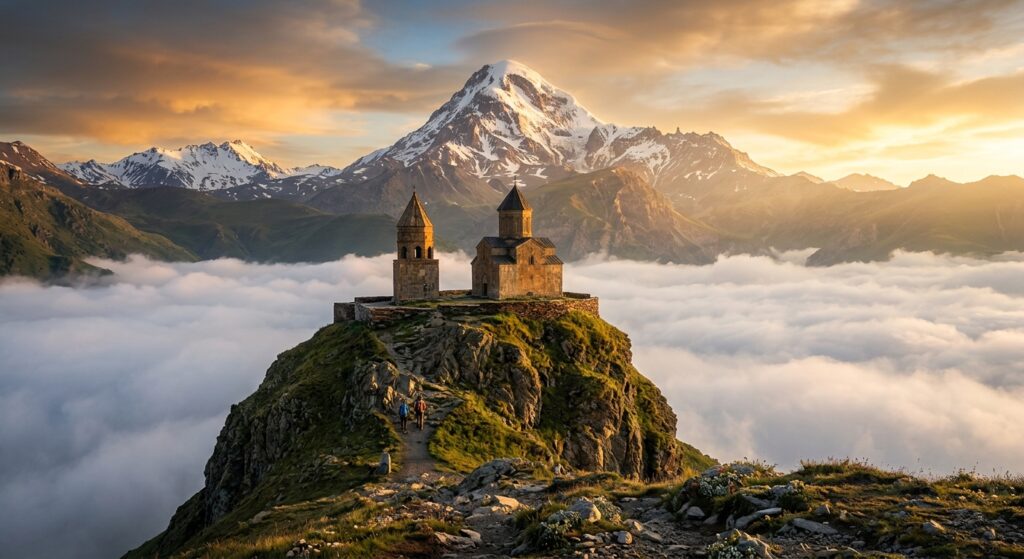
Four hours north of Tbilisi on the Georgian Military Highway, the town of Stepantsminda sits at 1,740 meters in the shadow of Mount Kazbek. At 5,047 meters, Kazbek is permanently snow-capped and impossible to look at without feeling something.
The Gergeti Trinity Church stands at 2,170 meters on a promontory above the clouds, with Mount Kazbek rising behind it. It is one of the most photographed buildings in the Caucasus — and one of the rare places where the reality exceeds the photograph.
The hike from Stepantsminda takes two to three hours through meadows full of wildflowers and past grazing horses. Local 4×4 drivers make the same journey for 30–50 GEL if hiking is not your preference. Go both directions — the descent in late afternoon light, valley spread below and village smoke rising, stays with you.
The town is small and genuine: family guesthouses, home-cooked meals, nothing else. Spend at least two nights. Find Kazbegi accommodation on Booking.com and book ahead in summer — rooms fill fast.
The drive from Tbilisi on the Georgian Military Highway passes the Ananuri fortress complex, the Zhinvali Reservoir, and the Gudauri ski resort. Every stop is worth making.
Mtskheta — Where Georgia Found Its Soul
Twenty minutes from Tbilisi, Mtskheta is one of the oldest continuously inhabited cities in the world and the spiritual heart of the Georgian Orthodox Church.
The Svetitskhoveli Cathedral, built in the 11th century, is the most important church in Georgia. Whether or not you have any interest in the religious history, the cathedral is a masterpiece of medieval architecture. Standing inside it, watching candlelight move across stone that has absorbed 1,700 years of prayer, is the kind of quiet moment that travel is actually for.
Across the river, the Jvari Church was built in the 6th century at the exact spot where Georgia converted to Christianity in 337 AD. The view from the terrace — two rivers converging, the old city below, mountains in every direction — is the same view the poet Lermontov wrote about in 1840. Nothing has changed.
Mtskheta is best visited as a morning half-day trip from Tbilisi. Marshrutka minibuses leave from Didube Bus Station for less than 1 GEL. No advance booking needed — just show up and go.
Batumi — The City That Surprises Everyone
Batumi sits on the Black Sea in southwestern Georgia and it does not belong. A subtropical climate in a mountain country. A skyline of glass towers above Soviet promenades. Casino hotels beside botanical gardens. Palm trees next to Orthodox churches.
It makes no sense and it is genuinely compelling.
The Black Sea is swimmable from June through September. The 7-kilometer seafront boulevard is lined with restaurants and cafes. The botanical garden above the city is one of the largest in the world, with plants from six climatic zones terraced up hillsides above the sea.
The real charm of Batumi is in its quieter corners — the Europa Square district has 19th century restored buildings, excellent coffee, and a pace entirely at odds with the casino strips.
Tbilisi to Batumi by overnight train is one of the pleasant rail journeys in the Caucasus, with tickets around 45 GEL. Search Batumi hotels on Booking.com — prices are significantly lower than comparable Black Sea destinations in Turkey.
Vardzia — The Cave City Most Visitors Miss
Carved into volcanic rock in southern Georgia, Vardzia is one of the most astonishing human constructions in the Caucasus — and one of the least-visited by international tourists.
Built in the 12th century by Queen Tamar, Vardzia was a monastic city capable of housing 50,000 people: hundreds of cave rooms cut 13 levels into a cliff face, with a church, throne room, wine cellar, and sophisticated irrigation system all intact. An earthquake in 1283 collapsed the facade and exposed the interior — a honeycomb of rooms open to the sky, still containing 13th century frescoes in extraordinary condition.
Combine Vardzia with a stop at Uplistsikhe cave town, Rabati Castle in Akhaltsikhe, and the Borjomi mineral springs for a two to three day southern Georgia road trip that almost nobody else is taking.
Kakheti Wine Region — 8,000 Years of Winemaking
Georgia is not just a wine country. It is the country where wine was invented.
Archaeological evidence from Kakheti dates wine production here to 6,000 BC — the oldest in the world by several thousand years. The traditional method, fermenting wine in clay vessels called qvevri buried underground, was inscribed by UNESCO as an Intangible Cultural Heritage of Humanity in 2013.
Kakheti produces 70% of Georgia’s wine and sits three hours east of Tbilisi. Every family has a basement full of wine. Stopping at any guesthouse will result in more being poured than you can reasonably manage, accompanied by food that appears from nowhere.
The Twins Wine House in Napareuli produces internationally recognised natural qvevri wines and is consistently cited as one of the best winery experiences in the region. A guided wine day tour from Tbilisi — including tastings, traditional lunch, and transport — costs $60–90 per person through operators on GetYourGuide.
Georgian Food — Why You Will Eat Better Here Than Almost Anywhere
Georgian food is the reason you will gain weight regardless of how active you are.
The khinkali: a dumpling filled with spiced meat and broth, held by the topknot, you bite a hole, drink the soup first, then eat the rest. It is a ritual as much as a food. Khachapuri is the other obsession — bread filled with cheese, most famously in the Adjarian boat shape with an egg and melted butter pooling into the center. Prices start at 4–6 GEL.
A full Georgian supra goes far beyond these two: walnut-stuffed eggplant, lobiani bean bread, shkmeruli chicken in garlic milk sauce, churchkhela candy strings, badrijani with walnut paste and pomegranate. Dishes arrive without warning and keep arriving.
The ingredients are fresh, seasonal, locally sourced in the way most farm-to-table restaurants spend years trying to approximate. A full meal with wine at a good Tbilisi restaurant costs 30–50 GEL — approximately $11–$19.
How Much Does Georgia Cost in 2026?
| Expense | Budget | Mid-Range | Comfortable |
|---|---|---|---|
| Accommodation (per night) | $15–25 | $40–70 | $80–150 |
| Meals (per day) | $10–15 | $20–35 | $40–60 |
| Local transport (per day) | $2–5 | $10–20 | $30–50 |
| Activities (per day) | $5–15 | $20–40 | $50–100 |
| eSIM (per week) | $4.50 — Airalo | $8 | $12 |
| Daily total | $35–60 | $90–165 | $200–360 |
A comfortable week in Georgia — good hotels, restaurant meals, day trips, a wine tour — costs approximately $600–$900 including your Georgia eSIM from Airalo. Compare that to a week in Greece or Portugal and the value difference is immediate.
Currency is the Georgian Lari. ATMs are widely available in Tbilisi and Batumi. Cards accepted everywhere in the capital. Outside Tbilisi, carry cash.
Getting Around Georgia
Marshrutka minibuses connect every town for almost nothing. Tbilisi to Kazbegi: 10 GEL. Tbilisi to Mtskheta: 1 GEL. They leave when full and stop on request.
Train connects Tbilisi to Batumi (5 hours, from 17 GEL) and Kutaisi (3 hours). The overnight Tbilisi–Batumi sleeper is worth taking for the experience.
Shared taxis are the most flexible option for groups. Negotiate a price before departing — expect 10–20 GEL more than the equivalent marshrutka fare.
Car rental is recommended for southern Georgia and wine country. Major routes are good; mountain roads require care. Rates from $30–50 per day.
Tbilisi metro covers all main areas efficiently. Single journeys cost 1 GEL. Bolt and Yandex taxis run 5–15 GEL for most city trips.
Practical Travel Information
Visa: Citizens of 98+ countries enter Georgia visa-free for up to 365 days. This includes EU, UK, USA, Canada, Australia, UAE, and Saudi Arabia. Verify the current list at the Georgian Ministry of Foreign Affairs website before traveling.
When to go: April–June and September–October for the best combination of weather and manageable crowds. July–August are hot and crowded especially in Batumi. Gudauri ski resort operates January–March.
Language: Georgian uses its own unique Mkhedruli script. Russian is spoken by older generations. English is common in Tbilisi and all tourist-facing businesses.
Internet and data: Excellent 4G coverage across all urban areas and tourist destinations. Get your Georgia eSIM from Airalo before you fly — plans from $4.50, active the moment you land. If you need unlimited data, Holafly’s Georgia eSIM is a strong alternative.
Safety: Georgia consistently ranks among the safest destinations in the region. Petty crime is low. Avoid the disputed regions of South Ossetia and Abkhazia.
Tipping: 10% at restaurants for good service. Not expected at street food stalls or markets.
Frequently Asked Questions
Is Georgia in Europe or Asia?
Georgia sits in the South Caucasus between the Black Sea and Caspian Sea. Culturally and politically, Georgia identifies as European and has held EU candidate status since 2023. For travelers, it feels like the extraordinary meeting point of both worlds.
Do I need a visa for Georgia in 2026?
Most nationalities do not. Citizens of the EU, UK, USA, Canada, Australia, UAE, Saudi Arabia, and 90+ other countries can enter visa-free for up to 365 days.
What is the best base for exploring Georgia?
Tbilisi. It sits in the center of the country with excellent connections to every region and deserves several days in its own right. Almost every destination in this guide is accessible as a day trip or overnight from the capital.
How many days do you need in Georgia?
Seven days covers Tbilisi, Kazbegi, Mtskheta, and wine country comfortably. Ten to fourteen days adds Batumi and the southern circuit. Georgia rewards slow travel.
What eSIM works best in Georgia?
Airalo offers the best value from $4.50. Holafly is best for unlimited data. Yesim works well if you are also visiting neighboring countries on the same trip. Read our full eSIM comparison guide for more detail.
Is Georgia safe for solo travelers?
Yes. Georgia is one of the safest solo travel destinations in the region. The concept of a guest being a gift from God shapes how you are treated everywhere you go.
Sources
- Georgian National Tourism Administration — International Visitor Arrivals 2024
- UNESCO Intangible Cultural Heritage — Traditional Georgian Qvevri Wine-Making, 2013
- Georgian Ministry of Foreign Affairs — Countries with Visa-Free Access
- Georgian Railway — Tbilisi to Batumi Timetable and Fares 2026
- Numbeo — Cost of Living in Tbilisi, June 2026
- Budget Your Trip — Georgia Average Daily Travel Costs