
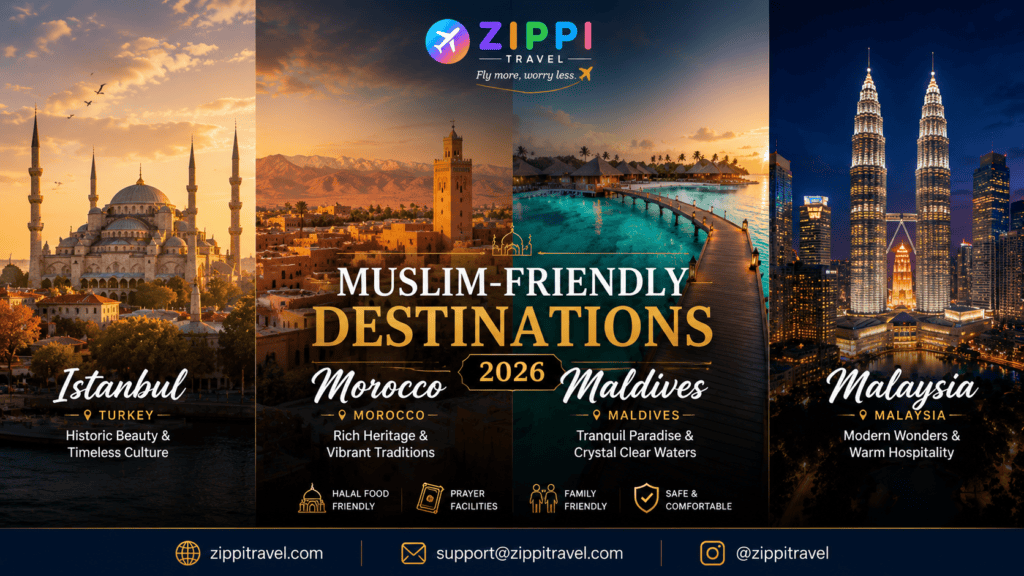
Travel should never feel like a compromise.
But for millions of Muslim travellers, it often does. Finding halal food in an unfamiliar city. Locating a prayer room in a busy airport. Feeling culturally comfortable in a country that does not share your values. These are real concerns — and they shape where people choose to go.
The good news: halal travel has never been stronger. A 2024 report by Mastercard and CrescentRating estimated the global Muslim travel market at US$220 billion — and growing. Destinations around the world are actively competing for Muslim visitors. New halal-certified restaurants are opening. Prayer facilities are expanding. Muslim-friendly travel infrastructure is improving everywhere on this list.
These are the 10 best Muslim-friendly travel destinations in 2026 — places where you can eat freely, pray comfortably, and explore without compromise. Some are Muslim-majority countries. Some are not. All of them are extraordinary.
✈️ Quick Answers
- Best fully halal destination: Turkey, Morocco, Maldives, UAE — Muslim majority with zero food concerns
- Best halal destination in Asia: Malaysia and Indonesia
- Best surprising halal destination: Japan — the halal scene has grown dramatically
- Best hidden gem for Muslim travellers: Bosnia & Herzegovina — European culture, Muslim heritage
- Best luxury halal destination: Dubai and Maldives
- Best value halal destination: Morocco and Azerbaijan
💚 Key Takeaways
✅ Turkey offers one of the most complete travel experiences in the world — history, food, beaches — with zero halal concerns
✅ Malaysia is Asia’s most Muslim-friendly destination — Malay, Indian, Chinese food cultures all operating side by side in halal
✅ Japan’s halal infrastructure has grown massively since 2020 — Tokyo and Osaka now have dedicated halal districts
✅ Bosnia is Europe’s best-kept secret for Muslim travellers — Ottoman heritage, European charm, halal food on every street
✅ The Maldives is not just halal — it is a Muslim-majority nation where the call to prayer echoes across the lagoon each evening
✅ Get your travel eSIM from Airalo before you fly — stay connected in all 10 destinations with one app
📋 Table of Contents
1. Turkey 🇹🇷 — The Greatest Muslim-Friendly Travel Destination on Earth {#turkey}
Best time to visit: April–June | September–November
Daily budget: US$50–100 (exceptional value)
Visa: e-Visa from evisa.gov.tr — US$40–60, approved in 24 hours
Halal status: ✅ Muslim-majority country — 99% of population Muslim
Prayer facilities: Mosques on every street in every city
Turkey is, by almost any measure, the most complete travel destination for Muslim travellers in the world.
Start with Istanbul. The Hagia Sophia — a 1,500-year-old structure that has been a church, a mosque, a museum, and now a mosque again — is one of the most historically layered buildings in human civilisation. The Blue Mosque sends the call to prayer across the Bosphorus five times a day. The Grand Bazaar has 4,000 shops operating across 60 streets. And the Bosphorus itself — the strait where Europe and Asia face each other across 700 metres of water — is one of the great natural divides of the world.
Beyond Istanbul, Turkey reveals itself as one of the most geographically varied countries on earth. Cappadocia is a lunar landscape of fairy chimneys and underground cities where early Christians hid from Roman persecution. The Turquoise Coast (Antalya, Bodrum, Fethiye) has beaches that rival anything in the Mediterranean. Ephesus is one of the best-preserved ancient Roman cities in existence.
And the food. Turkish cuisine is one of the great food cultures of the world — kebabs, meze, baklava, Turkish breakfast spreads, fresh-caught fish on the Bosphorus. All of it halal. All of it extraordinary.
Go Türkiye reports Turkey consistently ranks in the top 5 most visited countries in the world. In 2026, the Turkish lira remains weak against major currencies, making it one of the best-value destinations anywhere.
Top experiences:
- Hot air balloon over Cappadocia at sunrise — from US$150 on Klook
- Hagia Sophia — free entry, one of history’s most significant buildings
- Bosphorus cruise, Istanbul — from US$25, sunset is best
- Pamukkale thermal pools — natural white calcium terraces, from US$10
- Turkish hammam (bath) experience — Çemberlitaş Hammam, Istanbul, from US$40
- Ephesus ancient ruins — from US$15, guided tours available
Halal travel notes:
- Halal food is the universal standard — no checking required
- Mosques open for all five daily prayers including travellers
- Ramadan is a spectacular time to visit Istanbul — iftar spreads along the Bosphorus are unforgettable
- Alcohol is available in tourist areas but never pushed — easy to avoid entirely
2. UAE — Dubai 🇦🇪 — Luxury Without Limits {#dubai}
Best time to visit: November–April (outdoor season)
Daily budget: US$120–250
Visa: Visa-on-arrival for most nationalities | e-Visa at icp.gov.ae for others
Halal status: ✅ Muslim-majority country — 76% Muslim population
Prayer facilities: Prayer rooms in every mall, hotel, airport, and major attraction
Dubai has built something remarkable: a world-class luxury tourism destination that is also completely halal-friendly by default.
The Burj Khalifa (world’s tallest building at 828m), the Dubai Mall (world’s most visited shopping centre), the Palm Jumeirah (a palm-shaped artificial island visible from space), the gold souk with hundreds of tonnes of 18-carat and 22-carat gold on display — Dubai’s landmarks are genuinely extraordinary, and all of them operate within an Islamic framework.
Visit Dubai broke its own visitor record in 2024 with 17.1 million overnight guests. The trajectory in 2026 is higher still. For Muslim travellers specifically, Dubai represents the rare convergence of world-class infrastructure and complete cultural comfort.
Ramadan in Dubai is worth a visit in itself. The city transforms — hotels offer elaborate iftar buffets, the streets fill with families after sunset, and the atmosphere is uniquely communal in a way that is difficult to find in any other major global city.
Top experiences:
- Burj Khalifa At the Top observation deck — from US$30 on Klook
- Desert safari with halal BBQ dinner — from US$45
- Dubai Frame glass bridge — from US$14
- Gold Souk and Spice Souk, Deira — free, extraordinary sensory experience
- Dhow dinner cruise on Dubai Creek — from US$35
- Dubai Miracle Garden — 150 million flowers — from US$18
Halal travel notes:
- Every restaurant in Dubai operates on halal standards — alcohol is available only in licensed hotel venues
- Prayer rooms in every mall, attraction, and transport hub — often air-conditioned with ablution facilities
- Modest dress code applies in souks, mosques, and public spaces (abayas available to borrow at mosques)
- Dubai is one of the safest cities in the world for solo Muslim women travellers
Also read: 10 Best Honeymoon Destinations 2026 — Dubai is our top pick for Muslim couples
3. Morocco 🇲🇦 — Africa’s Most Magical Travel Destination {#morocco}
Best time to visit: March–May | September–November
Daily budget: US$50–90
Visa: Visa-free for most nationalities for 90 days
Halal status: ✅ Muslim-majority country — 99% Muslim population
Prayer facilities: Mosques in every neighbourhood, including historic medina mosques open to visitors
Morocco is three hours from London, four hours from New York, and feels like a completely different world.
The medinas of Marrakech and Fes are UNESCO World Heritage Sites where streets have not meaningfully changed in 500 years. Every morning, the call to prayer from the Koutoubia Minaret drifts across the rooftops of Marrakech before the city wakes. Every evening, the main square — Djemaa el-Fna — transforms into one of the greatest free shows on earth: storytellers, snake charmers, acrobats, musicians, and food stalls running in every direction.
Morocco in 2026 has extra energy. The country is co-hosting the 2030 FIFA World Cup with Spain and Portugal, and infrastructure investment is visible everywhere — new roads, upgraded airports, restored historic buildings. The country is preparing to show itself to the world, and what it is showing is extraordinary.
Visit Morocco reports record tourism growth since 2022. For Muslim travellers, Morocco offers something rare even among Muslim-majority destinations: a country where Islamic architecture, culture, and daily life are not just preserved — they are the main attraction.
Top experiences:
- Djemaa el-Fna square, Marrakech — free, spectacular every evening
- Fes medina — the world’s largest car-free urban area, completely medieval
- Sahara Desert overnight camp — camel trek at sunset, sleeping under stars — from US$65 on Klook
- Chefchaouen — the blue mountain city, entirely painted in shades of blue
- Atlas Mountains hike — Toubkal summit (4,167m), Africa’s highest peak outside Kilimanjaro
- Moroccan cooking class, Marrakech — from US$25, learn tagine and couscous
Halal travel notes:
- Halal food is the universal standard — pork is absent, alcohol is available only in tourist areas
- Mosques are generally not open to non-Muslim visitors — but the atmosphere and architecture are accessible from outside
- Ramadan transforms Moroccan cities — iftar is a community meal, often with strangers invited to join
- Women travellers: Morocco is generally safe, modest dress is appreciated in medinas
4. Malaysia 🇲🇾 — Asia’s Most Muslim-Friendly Destination {#malaysia}
Best time to visit: May–July and December–February (vary by region)
Daily budget: US$40–90
Visa: Visa-free for most nationalities for 90 days | Some require eVISA (malaysiavisa.gov.my)
Halal status: ✅ Muslim-majority country — 63% Muslim, with official halal certification system
Prayer facilities: Surau (prayer rooms) in every shopping mall, office building, and public space
Malaysia has built the world’s most advanced halal certification infrastructure — and built an entire tourism identity around it.
Kuala Lumpur is the entry point — a modern capital where the Petronas Twin Towers (452m, the world’s tallest twin towers) anchor a skyline that blends futuristic glass with colonial-era architecture and traditional Malay kampung houses. The food scene is extraordinary: Malay, Chinese, Indian, and fusion cuisines operating side by side, most of it halal, all of it excellent, much of it available for under US$5 from street stalls.
Tourism Malaysia has positioned Malaysia as the world’s top Muslim-friendly destination for multiple years running — and the infrastructure backs that claim. Halal-certified restaurants display official logos. Prayer rooms are in every level of every major mall. Duty-free halal products fill the airport shops.
Beyond KL, Malaysia offers extraordinary variety. Penang is one of the greatest food cities in Asia. Langkawi is a duty-free island with beaches and rainforest. Borneo (Sabah and Sarawak) has the most biodiverse rainforest in the world, wild orangutans, and tribal longhouses. Cameron Highlands produces the best tea in Asia from colonial-era plantations at 1,500 metres altitude.
Top experiences:
- Petronas Towers Skybridge and observation deck, KL — from US$18 on Klook
- Batu Caves Hindu temple — 272 rainbow-coloured steps, free entry
- Penang street food tour — Georgetown hawker stalls, from US$30
- Langkawi island day trip — cable car, eagle feeding, island hopping — from US$45
- Taman Negara National Park — one of the world’s oldest rainforests, from US$25
- Sandakan Orangutan sanctuary, Borneo — from US$30
Halal travel notes:
- Malaysia has a national halal certification body (JAKIM) — look for the JAKIM halal logo on restaurants
- Surau (prayer rooms) are so common they appear on mall directories alongside toilets and elevators
- Muslim-majority cities like Kota Bharu and Kuala Terengganu operate fully on Islamic principles
- Non-halal food (pork, alcohol) is available in Chinese restaurants and designated areas — easy to avoid
5. Maldives 🇲🇻 — Halal Paradise in the Indian Ocean {#maldives}
Best time to visit: November–April (dry season)
Daily budget: US$80–600 depending on accommodation type
Visa: Visa-on-arrival free for all nationalities (30 days)
Halal status: ✅ Muslim-majority country — 100% Sunni Muslim by law
Prayer facilities: Mosques on every inhabited island, prayer mats in resort rooms on request
The Maldives is the only country in this guide where being Muslim is, legally, a condition of citizenship.
Every inhabited island has a mosque. The call to prayer drifts across the lagoon five times a day. Pork and alcohol are prohibited on local islands entirely — though international resort islands (built on separate uninhabited islands) operate differently for international guests.
For Muslim travellers, local island guesthouses on inhabited Maldivian islands offer a completely halal experience: traditional Maldivian food (fish curry, flatbread, fresh coconut), prayer facilities steps from your door, and the same turquoise lagoon as the luxury resorts — for US$80–150/night instead of US$500.
Visit Maldives has actively promoted local island tourism as an alternative to resort islands, and the infrastructure has improved dramatically in the last three years. Fast ferry connections between local islands, certified halal restaurants, and growing guesthouse capacity make the Maldives more accessible than ever.
Top experiences (local island style):
- Sandbank picnic — transfer by speedboat to an uninhabited sandbank for the day — from US$30
- Snorkelling with reef sharks and sea turtles — free or guided from US$20
- Night fishing trip — traditional Maldivian fishermen, catch your own dinner — from US$25
- Dolphin watching cruise — sunset dhow cruise — from US$30 on Klook
- Whale shark snorkelling, South Ari Atoll — from US$100
Halal travel notes:
- Local islands: 100% halal — pork and alcohol completely absent
- Resort islands: international food standards — halal options always available alongside non-halal
- Prayer times observed on local islands — shops may close briefly during prayer times
- Ramadan on a local island in the Maldives is a uniquely peaceful experience
6. Japan 🇯🇵 — Asia’s Greatest Surprise for Muslim Travellers {#japan}
Best time to visit: March–April (cherry blossom) | October–November (autumn)
Daily budget: US$100–160
Visa: Visa-free for most Western and Asian passports | Check Japan Tourism Agency for your nationality
Halal status: ⭐ Growing fast — 2,000+ halal-certified restaurants nationwide
Prayer facilities: Growing — dedicated prayer rooms now in major airports, shopping centres, and tourist sites
Japan is not a Muslim-majority country. But it has done more to develop halal tourism infrastructure in the last five years than almost any non-Muslim country in the world.
The numbers tell the story. In 2015, Japan had fewer than 200 halal-certified restaurants. By 2026, that number has exceeded 2,000. Tokyo, Osaka, and Kyoto now have dedicated halal food districts. The Japan Halal Guide is a well-maintained English and Arabic resource that maps certified restaurants, prayer rooms, and Muslim-friendly hotels nationwide.
Why go? Because Japan is arguably the greatest travel experience in Asia — and increasingly, Muslim travellers can access it fully. Tokyo is unlike any city on earth. Kyoto has 17 UNESCO World Heritage Sites. The bullet train (Shinkansen) is a landmark experience in itself. And the culture — the extraordinary attention to detail, the cleanliness, the hospitality, the food — is without parallel.
Japan Tourism Agency actively promotes Japan as a Muslim-friendly destination and has published comprehensive guides for halal dining, prayer, and travel across all major regions.
👉 Read our full Japan guide: Things To Do in Japan Summer 2026
Top halal experiences:
- Tokyo’s Asakusa district halal food street — yakitori, ramen, and sushi all with halal certification
- teamLab Planets digital art experience, Tokyo — from US$32 on Klook
- Kyoto geisha district and traditional ryokan — ryokans can accommodate halal dietary needs with advance notice
- Fushimi Inari shrine — 10,000 torii gates, free, go at sunrise
- Mt. Fuji day trip — from US$55, halal bento boxes available at mountain stations
- Osaka’s Dotonbori food street — dedicated halal section
Halal travel tips for Japan:
- Download the Halal Navi app or HalalGourmet Japan before you go — essential for finding certified restaurants
- Many restaurants display the halal certification sign (crescent and star) in the window
- Konbini (convenience stores) like 7-Eleven and Lawson now stock halal-labelled onigiri and snacks
- Tokyo Camii (the largest mosque in Japan) is open to visitors — worth a visit regardless
7. Singapore 🇸🇬 — Southeast Asia’s Halal Food Capital {#singapore}
Best time to visit: Year-round (tropical climate)
Daily budget: US$80–160
Visa: Visa-free for 160+ nationalities for 30–90 days
Halal status: ✅ Excellent — 15% Muslim population with one of Asia’s most rigorous halal certification systems
Prayer facilities: Mosques in every residential area, prayer rooms in all major malls and Changi Airport
Singapore’s halal certification system (run by the Islamic Religious Council of Singapore, MUIS) is considered one of the most rigorous and reliable in the world. The MUIS halal logo is a guarantee, not just a label.
What this means practically: every single hawker centre in Singapore has halal-certified stalls. The famous Maxwell Food Centre, Lau Pa Sat, and Tekka Market all have MUIS-certified options. Chicken rice, laksa, nasi padang, roti prata, murtabak — Singapore’s most iconic dishes are all available in halal form, and the halal versions are identical in quality to any other.
Singapore Tourism Board has invested specifically in Muslim visitor infrastructure. The Arab Street district and Kampong Glam neighbourhood — Singapore’s historic Malay-Muslim quarter — have been beautifully restored and function as a cultural anchor for Muslim visitors while also being one of the most interesting areas in the city.
Singapore is also the easiest first international destination for many travellers — English-speaking, safe, clean, and completely navigable with an excellent public transport system.
👉 Read our full guide: Things To Do in Singapore 2026
Top halal experiences:
- Arab Street and Kampong Glam — Sultan Mosque, independent restaurants, batik shops — free
- Tekka Market halal hawker food — roti prata from US$1.50, biryani from US$4
- Gardens by the Bay — Supertree light show at 7:45pm, free to watch from the park
- Universal Studios Singapore — from US$64 on Klook
- Night Safari — from US$45, unique experience not available anywhere else in Asia
- Little India’s Mustafa Centre — 24-hour shopping, spices, textiles, halal snacks
Halal travel notes:
- Look for the MUIS crescent-and-star logo — Singapore’s gold standard for halal certification
- Changi Airport (consistently voted world’s best airport) has prayer rooms on every terminal level
- Singapore’s Muslim-majority neighbours in the south of the island give the city a particularly strong halal food scene
8. Bosnia & Herzegovina 🇧🇦 — Europe’s Hidden Halal Gem {#bosnia}
Best time to visit: April–October
Daily budget: US$40–80 (exceptional value for Europe)
Visa: Visa-free for most nationalities for 90 days
Halal status: ✅ Muslim-plurality country — 51% Muslim population
Prayer facilities: Ottoman mosques in every city and town
Most people do not know this. Bosnia and Herzegovina is a majority-Muslim country — in Europe.
Sarajevo, the capital, was the site of the 1984 Winter Olympics and the devastating siege of 1992–1995. It is also one of the most remarkable cities in Europe: an Ottoman-era bazaar (the Baščaršija) sits in the shadow of Austro-Hungarian architecture, which sits in the shadow of Yugoslav concrete, which sits next to brand-new glass towers. Four empires built this city, and the layers are still visible.
Mostar — a two-hour drive south — is the image of Bosnia: the Stari Most (Old Bridge), a 16th-century Ottoman stone arch bridge rebuilt after its deliberate destruction in 1993, spanning the Neretva River in the old city. On summer evenings, divers leap from the bridge 21 metres into the water below. It is one of the most beautiful scenes in Europe.
Bosnia Tourism actively promotes the country’s Muslim heritage alongside its extraordinary natural landscape: national parks, waterfalls, and mountains that reach 2,386 metres.
Why it matters for Muslim travellers: Ćevapi (grilled minced meat), burek (phyllo pastry with meat or cheese), and Bosnian coffee culture are all halal by default. Mosques from the Ottoman period are open and active. The culture is welcoming in a way that few European countries are for Muslim visitors.
Top experiences:
- Baščaršija bazaar, Sarajevo — Ottoman-era covered market, free to explore
- Stari Most (Old Bridge), Mostar — watch the divers, walk the bridge, free
- Vrelo Bosne park, Sarajevo — springs of the Bosna River, swan-filled lakes, free
- War Tunnel Museum, Sarajevo — the tunnel that kept Sarajevo alive during the siege — from US$5
- Kravice Waterfalls — Niagara-of-Bosnia, 25m waterfall into emerald pool — from US$3 entry
- Počitelj medieval fortress town — Ottoman architecture, river valley views
Halal travel notes:
- Ćevabdžinice (ćevapi restaurants), burek bakeries, and Bosnian restaurants are all halal by default
- Mosques from the 15th–16th centuries are open for prayer throughout the day
- Alcohol is available in some restaurants but easy to avoid — never pushed on customers
- Bosnia is one of the cheapest countries in Europe — a full meal costs US$5–8
9. Azerbaijan 🇦🇿 — The Silk Road’s Hidden Destination {#azerbaijan}
Best time to visit: April–June and September–October
Daily budget: US$50–90
Visa: e-Visa from evisa.gov.az (US$20–26, approved within 3 business days)
Halal status: ✅ Muslim-majority country — 97% Muslim population
Prayer facilities: Mosques throughout Baku and all regions
Azerbaijan sits where the Caspian Sea meets the Caucasus Mountains — and nobody talks about it enough.
Baku, the capital, is one of the strangest and most fascinating cities in the world. The UNESCO-listed Old City (Icheri Sheher) dates from the 12th century — medieval stone towers and caravanserais from the Silk Road era surrounded by a modern skyline anchored by the Flame Towers, three glass skyscrapers shaped like flames that light up the Caspian waterfront at night.
The country sits on natural gas seeps that have been burning for thousands of years — some permanently. Yanar Dag (Burning Mountain) is a hillside that has been on fire continuously for decades, flames leaping naturally from the ground. The ancient fire temple of Ateshgah (used by Zoroastrian, Hindu, and Sikh pilgrims for 2,000 years) uses the same eternal natural flames.
Azerbaijan Tourism has invested heavily in international promotion since 2018. Hotel quality has risen dramatically, English-language signage is improving, and the country is actively targeting Muslim tourists from Gulf states, Turkey, and beyond.
Top experiences:
- Old City (Icheri Sheher), Baku — UNESCO listed, medieval walls and Silk Road caravanserais — free
- Flame Towers light show from the Baku Boulevard — every night, free
- Yanar Dag (Burning Mountain) — permanently burning hillside — from US$2 entry
- Gobustan National Park — 6,000-year-old cave petroglyphs and mud volcanoes — from US$4
- Sheki — a Silk Road town with a summer palace covered in stained glass, from US$5 entry
- Caspian Sea waterfront — Baku Boulevard, 3.5km promenade, free
Halal travel notes:
- Halal food is standard in Azerbaijani cuisine — plov (pilaf), dolma (stuffed grape leaves), kebabs
- Mosques are open for prayer — Teze Pir Mosque in Baku is the main landmark
- Azerbaijan is a secular Muslim country — alcohol is available but easy to avoid
- Very friendly to visiting Muslim travellers from Gulf states (Arabic menus in some Baku restaurants)
10. Indonesia 🇮🇩 — The World’s Largest Muslim Country {#indonesia}
Best time to visit: April–October (dry season)
Daily budget: US$30–80
Visa: Visa-on-arrival for most nationalities (US$35, 30 days) | Some nationalities visa-free
Halal status: ✅ Muslim-majority country — 87% Muslim (the world’s largest Muslim population)
Prayer facilities: Mosques and surau (small prayer rooms) in every neighbourhood across the country
Indonesia is home to 277 million people — more than any other Muslim country on earth.
It is also one of the most geographically extraordinary nations in the world: 17,000+ islands stretching across 5,000 kilometres of ocean. Java has the ancient temples of Borobudur (9th-century Buddhist monument, one of the greatest structures ever built) and Prambanan (a 10th-century Hindu temple complex). Bali — the Hindu minority island within a Muslim-majority nation — is one of the most visited destinations in Southeast Asia. Lombok has a more relaxed version of Bali’s beaches with a Muslim cultural backdrop. Sulawesi has the extraordinary Torajan funeral culture. Raja Ampat is the most biodiverse marine environment on earth.
Indonesia Tourism promotes the country’s Muslim-friendly credentials aggressively — particularly for visitors from Gulf states and Malaysia. The Jakarta-Mecca Umrah flight corridor is one of the busiest religious travel routes in the world.
Top experiences:
- Borobudur sunrise tour — 9th-century Buddhist temple at dawn — from US$25 on Klook
- Bali rice terraces and temple tour — from US$20
- Raja Ampat island hopping — the world’s greatest diving destination — from US$60/day
- Komodo Island and Komodo Dragon — from US$80, UNESCO-listed national park
- Mount Bromo volcano sunrise — walk on an active volcanic crater rim — from US$35
- Lombok Gili Islands — three small islands with crystal water, no cars, no motorbikes — from US$10 boat
Halal travel notes:
- Java, Lombok, Sumatra, and most of Indonesia: halal food is the universal standard
- Bali is predominantly Hindu — halal restaurants are available but not universal; look for halal signs
- Friday prayers are taken seriously — expect some shops to close briefly around midday Friday
- Indonesian Islamic cuisine is extraordinary: rendang, soto, nasi goreng, gado-gado, martabak
📊 Full Comparison Table — All 10 Destinations {#comparison}
| Destination | Halal Level | Budget/Day | Visa | Best For | Peak Season |
|---|---|---|---|---|---|
| 🇹🇷 Turkey | ✅ Fully halal | US$50–100 | e-Visa | History, food, beaches | Apr–Jun |
| 🇦🇪 Dubai | ✅ Fully halal | US$120–250 | Visa on arrival | Luxury, scale, families | Nov–Apr |
| 🇲🇦 Morocco | ✅ Fully halal | US$50–90 | Visa-free | Medinas, desert, culture | Mar–May |
| 🇲🇾 Malaysia | ✅ Certified halal | US$40–90 | Visa-free | Food, cities, rainforest | May–Jul |
| 🇲🇻 Maldives | ✅ Muslim majority | US$80–600 | Free on arrival | Beaches, honeymooners | Nov–Apr |
| 🇯🇵 Japan | ⭐ Growing fast | US$100–160 | Visa-free (most) | Culture, food, temples | Mar–Apr |
| 🇸🇬 Singapore | ✅ MUIS certified | US$80–160 | Visa-free | First timers, families | Year-round |
| 🇧🇦 Bosnia | ✅ Majority halal | US$40–80 | Visa-free | Hidden gem, history | Apr–Oct |
| 🇦🇿 Azerbaijan | ✅ Majority halal | US$50–90 | e-Visa | Silk Road, unique culture | Apr–Jun |
| 🇮🇩 Indonesia | ✅ Fully halal | US$30–80 | Visa on arrival | Diversity, nature, temples | Apr–Oct |
🌙 10 Halal Travel Tips Every Muslim Traveller Should Know {#tips}
1. Download HalalTrip or Zabihah.com before every trip. Both are GPS-enabled apps that find halal-certified restaurants near your location in real time — available in 100+ countries.
2. Learn the local word for halal. In Japan: ハラール (hararu). In Malaysia/Indonesia: halal. In Turkey: helal. In French-speaking Morocco: halal. Knowing the word helps when menus are not in English.
3. Carry a compass or download a qibla app. Most Muslim-majority hotels provide qibla direction indicators in rooms — but in non-Muslim countries, an app like Muslim Pro removes any uncertainty.
4. Book hotels that confirm prayer facilities. Booking.com and Airbnb now have halal-friendly filters. For luxury hotels, call ahead and ask specifically — most major international chains can provide prayer mats and a qibla direction on request.
5. Check local prayer times before you plan your day. Apps like Muslim Pro or Athan give accurate salah times for any location in the world. Build your itinerary around prayer time windows rather than against them.
6. Ramadan travel is extraordinary — if you plan for it. Fasting in a Muslim-majority country during Ramadan is one of the most spiritually powerful travel experiences possible. The community iftar tables in Istanbul, Marrakech, and Kuala Lumpur are open to all visitors.
7. Airport connection halal food strategy. Dubai Airport (DXB), Kuala Lumpur Airport (KUL), and Istanbul Airport (IST) all have excellent halal food options in every terminal. These three airports are also major connecting hubs — plan connections through them if possible.
8. Seafood and vegetarian food is almost always safe. In destinations with limited halal certification (Japan, some parts of Europe), fresh seafood and vegetarian dishes eliminate cross-contamination concerns without needing certification.
9. Carry dates. Practically speaking, dates travel well, provide quick energy, and are part of the sunnah of breaking fast. Essential for travel days that cross prayer or iftar times.
10. Get an eSIM before you fly. The moment you land, you need internet access to find halal restaurants, prayer room locations, and qibla direction. An Airalo eSIM activates automatically when you land — no queuing, no SIM card, no guessing.
🌐 Travel Essentials {#essentials}
eSIM — Stay Connected the Moment You Land
Halal restaurant apps, qibla direction, prayer time apps — all require an internet connection. Get an eSIM before your trip so it activates automatically when you land.
👉 Get your travel eSIM on Airalo →
(Code: ZIPPITRAVEL for 5% off — covers all 10 destinations on this list)
Book Activities in Advance
Last-minute bookings mean sold-out slots. Every experience in this guide is available to book ahead on Klook — with free cancellation on most and instant confirmation.
❓ FAQ — Muslim-Friendly Travel 2026 {#faq}
Q: Which countries are 100% halal-friendly for Muslim travellers?
Turkey, Morocco, Maldives, and Indonesia are Muslim-majority countries where halal food is the universal standard and no checking is required. Malaysia has the world’s most rigorous halal certification system. Dubai (UAE) operates on halal standards throughout the city. Bosnia and Azerbaijan are Muslim-majority countries in Europe and Central Asia respectively.
Q: Which is the best Muslim-friendly destination in Asia?
Malaysia is consistently ranked as Asia’s top Muslim-friendly destination by the Global Muslim Travel Index — due to its JAKIM halal certification system, prayer rooms in every public building, and rich Islamic cultural heritage. Indonesia is the world’s largest Muslim country by population. Singapore has the most reliable halal certification system in Southeast Asia.
Q: Is Japan suitable for Muslim travellers?
Yes, and increasingly so. Japan now has 2,000+ halal-certified restaurants, dedicated Muslim prayer rooms in major airports and tourist sites, and apps like HalalGourmet Japan that map every certified option nationwide. Tokyo and Osaka are the most Muslim-friendly cities. With advance planning, Japan is highly accessible for Muslim travellers.
Q: What is the best halal destination in Europe?
Bosnia and Herzegovina is the best Muslim-friendly destination in Europe — a majority-Muslim country with halal food as the default, Ottoman-era mosques in every city, and visa-free access for most nationalities. Turkey (often considered trans-continental) and Azerbaijan are close alternatives. For Western Europe, London, Paris, and Berlin all have strong Muslim communities and certified halal restaurant scenes.
Q: Is it easy to find halal food in non-Muslim countries?
It depends on the destination. Singapore, Japan (in major cities), and the UK have strong halal dining scenes. France, Germany, and the Netherlands have significant Muslim populations with certified restaurants available. In smaller towns in non-Muslim countries, seafood and vegetarian options are the reliable fallback. Apps like Zabihah.com and HalalTrip GPS-locate certified restaurants anywhere in the world.
Q: Which destination is best for a halal honeymoon in 2026?
Dubai is the top choice — fully halal, world-class luxury, and extraordinary experiences. The Maldives (local island experience) is the most romantic. Istanbul offers the best value with extraordinary food and history. Morocco is perfect for couples who want culture and desert adventure alongside cultural comfort.
Q: What is the Global Muslim Travel Index?
The Global Muslim Travel Index (GMTI) is published annually by Mastercard and CrescentRating and ranks 140+ countries by Muslim-friendliness across criteria including halal food, prayer facilities, water-friendly washrooms, and Muslim-majority population percentage. Malaysia, Saudi Arabia, UAE, Indonesia, and Turkey consistently rank in the top 5. The 2025 index is available at crescentrating.com.
🌙 The World Is Open — Travel Without Compromise
Being a Muslim traveller in 2026 has never been easier.
The destinations on this list span four continents, six languages, and every budget level. They include some of the world’s most visited countries and some of its best-kept secrets. All of them welcome you. All of them feed you well. All of them give you space to pray.
The only thing left to decide is which one you book first.
👉 Get your eSIM before you fly — Airalo → (Code: ZIPPITRAVEL — 5% off)
Written by the ZippiTravel Team — Fly more, worry less.