
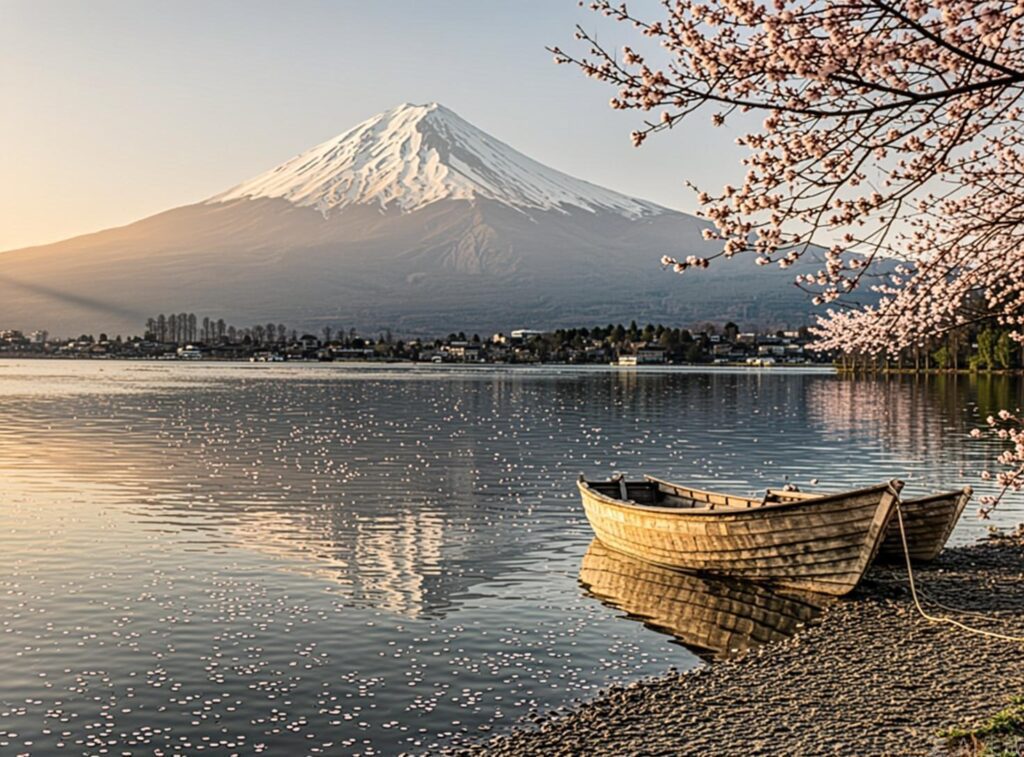
There is a moment on the Tokaido Shinkansen, about 40 minutes out of Tokyo, when the clouds part and you see it for the first time.
A perfect white cone rising above everything. Impossibly symmetrical. Snow-capped even in summer. Enormous in a way that no photograph has ever fully captured.
You understand immediately why Japan chose this mountain as its symbol. You understand why artists have painted it ten thousand times. You understand why pilgrims have been climbing it for over a thousand years.
Mount Fuji is not just a mountain. It is the closest thing Japan has to a national soul — and in 2026, it is still the single most sought-after experience in the country for travelers from around the world.
This is your complete guide to visiting Mount Fuji.
Key Takeaways
- Height: 3,776 meters — Japan’s highest mountain
- Location: On the border of Yamanashi and Shizuoka prefectures, about 100km southwest of Tokyo
- Climbing season: July and August only — the mountain is officially open for climbing these two months
- Best time to see it: Early morning, late evening, and colder months for clearest views
- Best base: Fuji Five Lakes region or Hakone
- eSIM: Get a Japan eSIM from Airalo from $3.50 — navigation is essential on the mountain
- From Tokyo: 2 hours by bus or train to the Fuji Five Lakes area
Table of Contents
- Why Mount Fuji Still Stops Every Traveler in Their Tracks
- Climbing Mount Fuji — What You Need to Know Before You Go
- The Four Climbing Routes Explained
- Fuji Five Lakes — The Best Base for Mount Fuji
- Hakone — Mount Fuji With a Hot Spring View
- Best Viewpoints for Mount Fuji Without Climbing
- Seeing Mount Fuji From the Shinkansen
- How to Get to Mount Fuji From Tokyo
- Where to Stay Around Mount Fuji
- What Does a Mount Fuji Trip Cost in 2026?
- Practical Travel Tips
- Frequently Asked Questions
- Sources
Why Mount Fuji Still Stops Every Traveler in Their Tracks
Japan has thousands of beautiful places. It has ancient temples, neon cities, bamboo forests, coastlines, and mountain villages that would be the headline attraction of any other country. But ask any traveler what they most want to see in Japan, and the answer is almost always the same.
Mount Fuji.
At 3,776 meters, Fujisan is Japan’s highest peak and an active volcano — it last erupted in 1707, and geologists classify it as potentially active today. But it is the shape of the mountain, more than any fact about it, that has made it one of the most recognized natural landmarks on earth. The near-perfect cone, the white snow cap, the way it rises alone from the surrounding plains without foothills to diminish it — there is no other mountain that looks quite like this.
It has been worshipped as a sacred mountain for over a thousand years. It has been painted by Hokusai 36 times in his famous series. It appears on postcards, on currency, in every travel brochure Japan has ever produced.
And yet the reality of seeing it in person — from the window of a bullet train, from the shore of Lake Kawaguchi, or standing on its summit in the pre-dawn cold — still exceeds every expectation.
Before you go, pick up a Japan eSIM from Airalo starting from $3.50. The mountain trails require navigation apps and the bus schedules to the 5th Station are complex — you want working data from the moment you land in Tokyo.
Climbing Mount Fuji — What You Need to Know Before You Go
The most important thing to know about climbing Mount Fuji: the mountain is only officially open for climbing during July and August.
Outside this window, the summit facilities — the mountain huts, the toilets, the rescue services — are closed. Snow and ice make the upper sections extremely dangerous without specialist equipment. Every year, people attempt Mount Fuji out of season and require rescue or worse. The official climbing season exists for very good reasons.
During July and August, however, the mountain is accessible and the experience is extraordinary. Most climbers follow the same pattern: take a bus or taxi to one of the 5th Stations (around halfway up the mountain at approximately 2,300 meters), rest and acclimatize, then begin the climb in the late afternoon or evening to reach the summit for sunrise. The Japanese word for this is goraiko — and watching the sun rise above the clouds from 3,776 meters is one of the most transcendent experiences Japan offers.
The climb from 5th Station to the summit takes 5–8 hours depending on fitness and route. The descent takes 3–5 hours. It is strenuous but not technical — no ropes or specialist equipment required during the official season.
What to bring:
- Warm layers — the summit is cold even in August, often below 5°C
- Waterproof jacket — weather changes rapidly
- Headlamp for night climbing
- Plenty of water and snacks (mountain huts sell food at high prices)
- Trekking poles — highly recommended for the descent
- Cash — mountain huts and the summit facilities are cash only
- Fully charged phone with offline maps downloaded and your Japan eSIM from Airalo active
Altitude sickness is real on Mount Fuji. Ascend slowly, stay hydrated, and do not push through severe headaches or nausea. Mountain huts at around 3,000 meters are available to rest — and many climbers spend a night in a hut to acclimatize before continuing to the summit.
Book mountain hut accommodation early — they sell out weeks in advance during peak climbing season. Search mountain area accommodation on Booking.com for base camp options near the 5th Stations.
The Four Climbing Routes Explained
Mount Fuji has four main climbing routes, each starting from a different 5th Station on a different side of the mountain.
| Route | 5th Station Altitude | Difficulty | Crowd Level | Best For |
|---|---|---|---|---|
| Yoshida (Subaru Line) | 2,300m | Moderate | Very High | First-timers, most facilities |
| Subashiri | 2,000m | Moderate | Medium | Quieter experience |
| Gotemba | 1,440m | Hard | Low | Serious hikers only |
| Fujinomiya | 2,400m | Moderate | Medium | Southern approach |
Yoshida Route (Subaru Line 5th Station) is the most popular by far — around 60% of all climbers use this route. It has the most mountain huts, the best facilities, and the most reliable transport connections from Tokyo. If it is your first time climbing Mount Fuji, start here.
Subashiri Route starts at the Subashiri 5th Station on the eastern slope and is significantly quieter than the Yoshida route while offering similar difficulty. The two routes merge in the upper sections.
Gotemba Route starts at the lowest 5th Station (1,440 meters) making it the longest and most demanding route — add 3–4 hours to any other route estimate. The volcanic sand descent trail (osunabashiri) is unique and exhilarating, but this route is for experienced hikers only.
Fujinomiya Route approaches from the south — the side facing the coast and easier to access from Osaka or Kyoto than from Tokyo. The Fujinomiya 5th Station is the highest starting point at around 2,400 meters.
Book tours from Tokyo that include transport, guide, and equipment through GetYourGuide’s Mount Fuji climbing tours — prices start from approximately ¥9,500 and remove the complexity of organizing transport to the 5th Stations independently.
Fuji Five Lakes — The Best Base for Mount Fuji
The Fuji Five Lakes region (Fujigoko) at the northern foot of the mountain is the finest base for experiencing Mount Fuji at a leisurely pace — and the most beautiful place to be if climbing is not your plan.
Five lakes sit in the shadow of the mountain, each with its own character:
Lake Kawaguchi (Kawaguchiko) is the most accessible and most visited — the northern shore offers the classic Mount Fuji reflection shot that appears on every postcard of Japan. The lakeside town has excellent restaurants, ryokan (traditional Japanese inns), and direct bus connections from Tokyo’s Shinjuku Station.
Lake Yamanaka is the largest of the five lakes and slightly further east — popular with windsurfers and less crowded than Kawaguchi.
Lake Sai sits closest to the ancient Aokigahara forest on the western side of the mountain — quieter and more atmospheric than the eastern lakes.
Lake Motosu is famous as the view depicted on the old ¥1,000 note — the perfect reflection of Mount Fuji from the western shore. The road around the lake is largely undeveloped and beautiful.
Lake Shoji is the smallest and most remote of the five — almost no tourist infrastructure, which is entirely the point.
The best time to see Mount Fuji from the Fuji Five Lakes is early morning in winter or spring — clear cold air, snow on the peak, perfect reflection in the still water. Visibility is typically poor in July and August due to summer haze and clouds.
Browse ryokan and hotels in the Fuji Five Lakes area on Booking.com — traditional lakeside ryokan with Mount Fuji views book out months in advance. Fufu Kawaguchiko and Konanso are consistently rated among the best.
Hakone — Mount Fuji With a Hot Spring View
One hour from Tokyo by the Romancecar express train, Hakone is Japan’s most popular hot spring resort — and on a clear day, it offers some of the finest views of Mount Fuji from any onsen (hot spring bath) in the country.
Hakone sits inside a vast volcanic caldera and the landscape reflects this: sulfurous Owakudani valley, Lake Ashi with its famous torii gate rising from the water, a ropeway floating above clouds of steam, and everywhere the scent of mineral springs.
The classic Hakone experience is the Hakone Loop — a one-day circuit by train, ropeway, boat, and bus that takes you through the park’s best scenery. On a clear day, Mount Fuji presides over everything from the north. On a cloudy day — which is common in Hakone — it is entirely invisible.
Hakone viewing tip: The best Mount Fuji views from Hakone are from the Owakudani area and from Lake Ashi’s Hakone-en side, in the morning before cloud builds. If you do not see it the first day, the morning of your second day often rewards patience.
Search Hakone accommodation on Booking.com — the ryokan here are among the finest traditional inns in Japan. Read our internal link to Japan eSIM guide for data coverage tips across the Hakone and Fuji area.
Best Viewpoints for Mount Fuji Without Climbing
You do not need to climb Mount Fuji to experience it fully. Some of the most powerful encounters with the mountain happen at its base, from the surrounding lakes, or from unexpected vantage points across the region.
Lake Kawaguchi North Shore — the single most photographed Mount Fuji viewpoint. Arrive before 8am for the best light and the stillest water reflections.
Chureito Pagoda, Arakurayama Sengen Park — a five-storey red pagoda on a hillside above Fujiyoshida city, with Mount Fuji framed behind it. This is the image that has made it onto millions of Instagram posts. 400 steps to reach the viewpoint. Worth every one.
Owakudani, Hakone — Mount Fuji seen over volcanic steam vents on the ropeway between Sounzan and Togendai. Extraordinary on a clear day.
Lake Motosu — the western lake with the classic perfectly symmetrical reflection formerly on the ¥1,000 note.
Tokaido Shinkansen — see the next section.
Nihondaira, Shizuoka — a plateau on the southern side with views across the Pacific coast and Fuji rising behind. Less visited by international tourists, entirely spectacular.
Seeing Mount Fuji From the Shinkansen
One of the most effortless ways to see Mount Fuji requires nothing except a Shinkansen ticket between Tokyo and Osaka, Kyoto, or Nagoya.
Take the Tokaido Shinkansen from Tokyo heading southwest. Sit on the right side of the train (window seat, D or E seat). Approximately 40–45 minutes after departure, around Shin-Fuji Station, Mount Fuji appears through the window.
It lasts about 30–60 seconds at bullet train speed. Have your camera ready. The light is best in the morning going outbound from Tokyo (the mountain catches morning sun on the right-hand side).
Important caveat: clouds block the view frequently, especially in summer. Mount Fuji visibility from the Shinkansen is better in winter and spring than in summer, and better in the morning than the afternoon. It is worth attempting but worth treating as a bonus rather than a certainty.
How to Get to Mount Fuji From Tokyo
By direct bus (recommended): Keio Bus and Fujikyu Highland Bus run direct services from Shinjuku Station to Kawaguchiko Station and the Subaru Line 5th Station. Journey time approximately 2 hours. Tickets around ¥1,700–2,000 one way. This is the easiest option for most travelers.
By train: Take the JR Chuo Line from Shinjuku to Otsuki (1 hour), then transfer to the Fujikyu Railway to Kawaguchiko Station (50 minutes). Slower than the bus but covered by Japan Rail Pass.
By Shinkansen + local transport: From Tokyo take the Shinkansen to Mishima or Shin-Fuji, then local bus to the Fujinomiya 5th Station. Best option if approaching from the southern side.
During climbing season: Direct buses run from Tokyo, Shinjuku, and the Fuji Five Lakes area to all four 5th Stations. Check Japan Guide’s seasonal bus page for current schedules.
Where to Stay Around Mount Fuji
Fuji Five Lakes (Kawaguchiko) — best for climbing access and lakeside views. Stay at a traditional ryokan for the full experience. Browse on Booking.com.
Hakone — best for hot springs and atmosphere. Higher prices but extraordinary experience. Browse Hakone hotels on Booking.com.
Fujiyoshida — budget-friendly city at the base of the mountain. Good access to the Yoshida trail and the Subaru Line 5th Station.
Mountain huts — for climbers who want to spend a night on the mountain and summit at sunrise. Book months in advance for the peak July–August season. Cash only.
What Does a Mount Fuji Trip Cost in 2026?
| Expense | Budget | Mid-Range | Comfortable |
|---|---|---|---|
| Accommodation (per night) | ¥3,000–6,000 (hostel) | ¥10,000–20,000 (hotel) | ¥25,000–60,000+ (ryokan) |
| Transport Tokyo → Fuji | ¥1,700 (bus) | ¥3,000 (train) | ¥6,000+ (private) |
| Climbing fee (conservation) | ¥2,000 per person | ¥2,000 | ¥2,000 |
| Mountain hut overnight | ¥7,000–8,000 | ¥9,000–12,000 | N/A |
| Meals per day | ¥1,500–3,000 | ¥3,000–6,000 | ¥8,000+ |
| eSIM | $3.50 — Airalo | $8 | $15 |
| Daily total (ex-accommodation) | ¥5,000–8,000 | ¥10,000–20,000 | ¥25,000+ |
Note: A ¥2,000 trail conservation fee applies to climbers on the Yoshida Route during the official climbing season. It is mandatory and collected at the entrance gate on the trail.
Practical Travel Tips
Visibility is never guaranteed. Mount Fuji is covered by clouds roughly 60% of the time in summer. Build flexibility into your schedule and plan for the possibility of not seeing it clearly on a given day. Staying 2–3 nights in the Fuji Five Lakes area dramatically increases your chances of at least one clear morning.
Fuji Five Lakes in winter and spring offers the most spectacular views — clear air, snow on the peak, perfect reflections in the lakes. The mountain is not climbable but the scenery is at its finest.
Start your climb in the evening. Most climbers leave the 5th Station between 8pm and midnight to arrive at the summit for sunrise around 4:30–5am. Climbing in darkness is easier than the midday heat, and the sunrise is the whole point.
The descent is harder on your knees than the ascent. Trekking poles are more useful going down than going up. Take your time on the sandy volcanic sections.
Stay hydrated. Altitude dehydration is a common reason climbers need assistance on the mountain. Drink water regularly even if you do not feel thirsty.
Get your eSIM before flying. Airalo Japan plans start at $3.50 and activate instantly. You need working data for bus schedules, navigation, and weather apps throughout the Fuji Five Lakes area.
Book everything early for July and August. The Fuji Five Lakes region and Hakone fill to capacity during the climbing season and school summer holidays. Accommodation and bus tickets should be booked at least 4–6 weeks in advance.
Frequently Asked Questions
When is the best time to climb Mount Fuji?
The official climbing season is July and August. The mountain is officially open during these two months only, with all trail facilities, mountain huts, and rescue services operational. Early July and late August tend to be less crowded than peak mid-August.
How hard is it to climb Mount Fuji?
Challenging but achievable for anyone with reasonable fitness. No technical climbing skills required during the official season. The altitude is the main difficulty — take it slowly, stay hydrated, and do not underestimate the cold at the summit even in summer.
Can you see Mount Fuji from Tokyo?
Yes — on clear days Mount Fuji is visible from Tokyo, particularly from elevated spots like the Tokyo Skytree observation deck or Shinjuku high-rise areas. Winter and spring mornings offer the best visibility. Summer haze often obscures the view.
Is there a fee to climb Mount Fuji?
Yes. A ¥2,000 (approximately $13) trail conservation fee applies to climbers on the Yoshida Route. It is mandatory during the climbing season and used for trail maintenance and environmental management.
What eSIM should I use in Japan?
Airalo’s Japan eSIM starts at $3.50 and provides excellent coverage across the Fuji Five Lakes, Hakone, and all major tourist areas. Activate before you fly so navigation works from the moment you land at Narita or Haneda.
Is Hakone or Fuji Five Lakes better for viewing Mount Fuji?
Both are excellent — they serve different purposes. Fuji Five Lakes puts you at the base of the mountain with the classic lakeside reflection shots and direct climbing access. Hakone combines Mount Fuji views with hot springs and a broader national park experience. If you have time, do both.
Can I climb Mount Fuji in winter?
No. The mountain is officially closed from September through June. Snow, ice, and extreme weather make it genuinely dangerous without specialist mountaineering equipment and experience. Only highly experienced alpine climbers with proper gear attempt it outside the official season.