
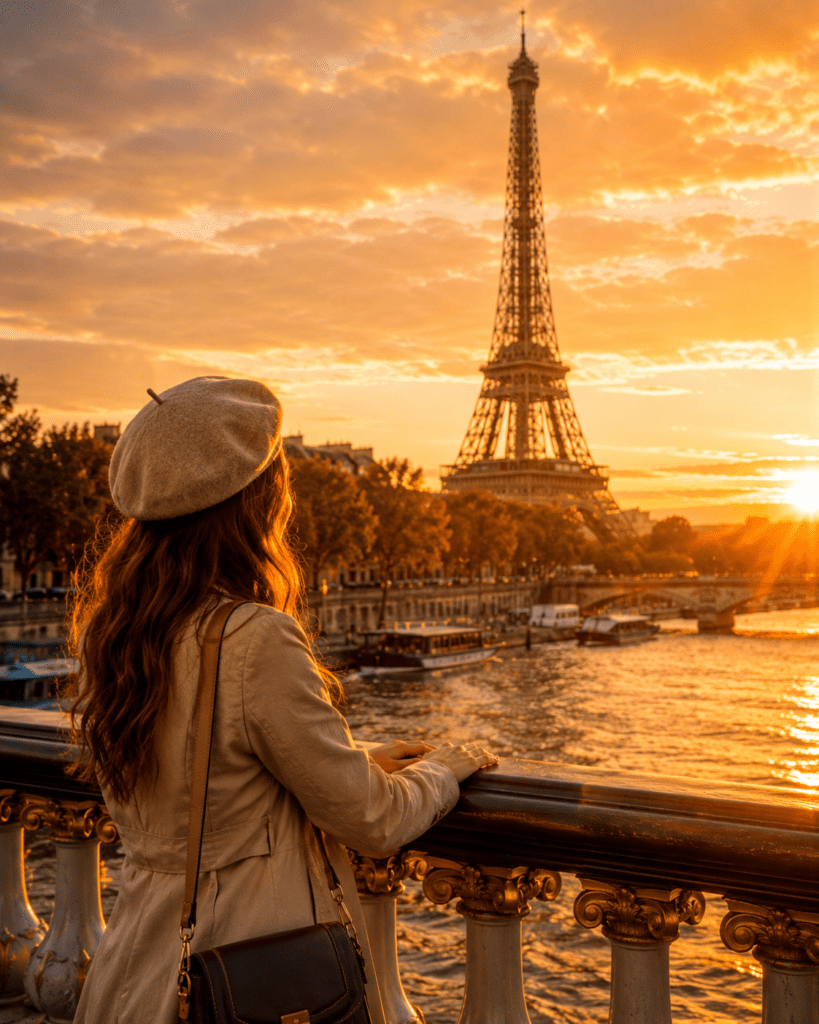
Nobody forgets their first time in Paris.
There is something about that moment — stepping out of the Métro at Trocadéro, turning a corner, and suddenly seeing the Eiffel Tower standing there in real life exactly as you have imagined it a thousand times before — that simply does not happen anywhere else on earth. Paris delivers on its promise in a way very few cities ever do.
But Paris can also be overwhelming for first-timers. It is a massive, fast-moving, endlessly layered city that rewards people who arrive with a plan and punishes those who show up and wing it. The tourist traps are real. The crowds are real. The cost of doing things wrong — eating at the wrong places, visiting the wrong attractions at the wrong times, getting on the wrong Métro line — can eat your budget and your patience alive.
This guide exists so that does not happen to you.
This is the complete five-day Paris itinerary for first-time visitors in 2026 — built around what actually matters, what is genuinely worth your time and money, and how to experience the real magic of the most visited city on the planet without any of the headaches.
✈️ Key Takeaways
- Best time to visit Paris in 2026: April–June or September–October — warm weather, manageable crowds, best photography light
- How many days do you need: 5 days is the sweet spot for first-timers — enough to cover the highlights without rushing
- Average daily budget: €80–€150 per day depending on accommodation and dining style
- Getting around: The Paris Métro is world-class and covers everything — a weekly Navigo pass is the best value
- Must book in advance: Eiffel Tower summit, Louvre Museum, Versailles, and popular dinner restaurants — all fill up weeks ahead
- eSIM tip: Get a travel eSIM before you fly so Google Maps works from the moment you land at CDG
📋 Table of Contents
- Why Paris in 2026 Is Worth Every Penny
- When to Visit Paris
- Getting to Paris
- Getting Around Paris
- Where to Stay in Paris
- Day 1 — Iconic Paris: Eiffel Tower, Champs-Élysées & Seine
- Day 2 — Art & History: The Louvre, Notre-Dame & Île de la Cité
- Day 3 — Montmartre, Sacré-Cœur & Hidden Paris
- Day 4 — Palace of Versailles Day Trip
- Day 5 — Le Marais, Shopping & Final Evening
- What to Eat in Paris: A First-Timer’s Food Guide
- Paris Budget Guide 2026
- Frequently Asked Questions
- Final Verdict
Why Paris in 2026 Is Worth Every Penny {#why-paris}
Paris receives more international visitors than almost any city on earth — and it has for decades. There is a reason it keeps drawing people back year after year, generation after generation.
The food is unlike anywhere else. The architecture tells 2,000 years of human history in a single walk. The museums hold more world-class art than you could see in a month. The café culture is genuinely unique — nowhere else do people sit at a pavement table for two hours over a single coffee and consider it a perfectly productive afternoon.
In 2026, Paris carries an extra layer of energy. The city is still buzzing from the 2024 Olympics, which left behind upgraded transport infrastructure, renovated public spaces, and a renewed confidence in the city’s international appeal. The Eiffel Tower has been freshly maintained, the Seine riverbanks have been beautifully transformed for pedestrians, and several major museum renovations completed in 2025 mean more of the city’s greatest collections are now on display than ever before.
If you have been waiting for the right time to visit Paris — this is it.
When to Visit Paris {#when-to-visit}
Paris is a year-round destination but it is not equal in every season.
April to June is widely considered the best time for first-timers. The weather is warm and comfortable, the city’s parks and gardens are in full bloom, daylight hours are long, and the summer peak crowds have not yet arrived. Hotel prices are reasonable compared to July and August.
September and October are equally excellent. The summer crowds thin out significantly after early September, temperatures remain warm through most of October, and the autumn light makes the city look extraordinary. This is when many Parisians return from their August holidays and the city feels fully alive again.
July and August are the busiest and most expensive months. Queues at major attractions stretch for hours, hotel prices peak, and frankly much of the city’s local population leaves Paris entirely for their own holidays. If July or August is your only option, book everything months in advance and arrive at attractions at opening time.
November to March is quieter, cheaper, and genuinely charming in the right conditions — Paris in December with Christmas markets and winter lights is magical. However, rain is frequent and some days are genuinely cold. Pack accordingly if you visit in winter.
Getting to Paris {#getting-there}
By Air
Paris is served by two major international airports. Charles de Gaulle (CDG) is the primary hub, located about 25 kilometres northeast of the city centre, and handles the vast majority of long-haul intercontinental flights from the Americas, Asia, Africa, and the Middle East. Orly (ORY) is the secondary airport to the south, primarily handling European routes.
From CDG to central Paris, the RER B train is the most efficient and affordable option — a direct journey to Gare du Nord takes approximately 35 minutes and costs around €11.80. Taxis are available but cost €55–€70 depending on destination and traffic, and the new flat-rate CDG taxi fares introduced in 2024 have made pricing more transparent.
By Eurostar from London
For travelers already in the United Kingdom, the Eurostar train through the Channel Tunnel remains one of the great travel experiences in Europe. London St Pancras to Paris Gare du Nord takes 2 hours 16 minutes, arriving right in the heart of the city. Book in advance for prices from £39 each way.
Setting Up Your eSIM Before You Land
One of the most practical things you can do before flying to Paris is activating a travel eSIM for France or Europe. The moment your plane lands at CDG, you will want Google Maps, your hotel address, and your transfer directions working immediately. Hunting for airport Wi-Fi while jet-lagged is not the Paris arrival experience you want.
Airalo, Holafly, and Yesim all offer excellent France and Europe eSIM plans that activate instantly via QR code and work across all French mobile networks.
👉 Browse Airalo’s France and Europe eSIM plans
👉 View Holafly’s unlimited France data plans
Getting Around Paris {#getting-around}
The Paris Métro is one of the finest urban transport systems in the world. Sixteen lines cover the entire city and its inner suburbs, trains run frequently from around 5:30am until after midnight (and all night on Fridays and Saturdays), and almost every major attraction is within a short walk of a Métro station.
Best option for a week’s stay: The Navigo Semaine (weekly pass) covers unlimited travel on all Métro, RER, bus, and tram lines within Paris for a flat weekly rate. For five or more days, this is almost always the best value option.
Walking is underrated. Paris is a compact city and many of the most memorable moments happen between destinations rather than at them. The walk from the Louvre to Notre-Dame along the Seine, or from Montmartre down through the 9th arrondissement, reveals the city in ways no Métro journey ever can. Build walking time into your itinerary and leave space for getting pleasantly lost.
Vélib bikes are Paris’s excellent public bicycle sharing scheme. Stations are everywhere and short rides are very affordable. For exploring flat areas like the Marais or the riverbanks, cycling is a genuinely enjoyable option.
Avoid taxis and Uber for short urban trips. Paris traffic can be severe during rush hours and you will often arrive faster on the Métro for a fraction of the cost.
Where to Stay in Paris {#where-to-stay}
Paris is divided into 20 arrondissements (districts) arranged in a spiral from the city centre. For first-timers, where you stay significantly shapes your experience.
| Area | Best For | Price Range |
|---|---|---|
| 1st & 2nd (Louvre, Châtelet) | Central location, walking to everything | €€€ |
| 3rd & 4th (Le Marais) | Trendy, vibrant, excellent food scene | €€–€€€ |
| 5th & 6th (Latin Quarter, Saint-Germain) | Classic Paris atmosphere, literary history | €€–€€€ |
| 7th (Eiffel Tower) | Quiet, upscale, stunning tower views | €€€ |
| 9th & 10th (Opéra, Canal St-Martin) | Lively, affordable, excellent transport links | €–€€ |
| 18th (Montmartre) | Bohemian, artistic, hilly and charming | €–€€ |
Recommendation for first-timers: The 3rd and 4th arrondissements in Le Marais give you the best combination of central location, atmosphere, restaurant options, and value. You are walking distance from Notre-Dame, a short Métro ride from the Louvre, and surrounded by some of the best food streets in the city.
Day 1 — Iconic Paris: Eiffel Tower, Champs-Élysées & Seine {#day1}
Your first day in Paris should be devoted entirely to the icons. Yes, they are famous. Yes, every tourist does them. And yes, they are still completely worth it.
Morning — Eiffel Tower
Book your Eiffel Tower tickets well in advance — ideally weeks before you arrive. Same-day tickets sell out consistently and the queue for walk-up access can exceed three hours in peak season. Arrive at your time slot at opening time (9am) and head straight for the summit elevator.
The view from the top on a clear day is genuinely one of the great city panoramas in the world. You can see from Notre-Dame to La Défense, from Montmartre to the Bois de Boulogne. Take your time. Breathe it in.
After descending, walk through the Champ de Mars gardens behind the tower for the most famous ground-level Eiffel Tower photographs. The symmetrical view from the end of the park with the tower centered behind you is one of the most photographed spots on earth for excellent reason.
Afternoon — Champs-Élysées and Arc de Triomphe
Walk or take the Métro to the Champs-Élysées — the grand boulevard that is arguably the most famous street in the world. Walk its full 1.9 kilometre length from Place de la Concorde up to the Arc de Triomphe. The avenue itself is largely luxury shops and chain restaurants, but its scale and grandeur are genuinely impressive.
Climb to the top of the Arc de Triomphe for a bird’s eye view down all twelve radiating avenues including the full length of the Champs-Élysées. The ticket cost is modest and the view is extraordinary.
Evening — Dinner and the Seine at Night
Paris at night along the Seine is one of those travel experiences that photographs cannot capture. After dinner — book a table at a traditional French brasserie in the 7th or nearby — walk along the riverbanks as the city lights reflect on the water and the Eiffel Tower’s hourly light show illuminates the sky.
The light show runs for five minutes at the top of every hour after sunset. Position yourself at Trocadéro or on the Pont d’Iéna bridge for the best view.
Day 2 — Art & History: The Louvre, Notre-Dame & Île de la Cité {#day2}
Morning — The Louvre
The Louvre is the largest art museum in the world and home to some of the most famous objects humanity has ever created. The Mona Lisa, Venus de Milo, Winged Victory of Samothrace, and thousands of other extraordinary works fill 72,735 square metres across three wings.
Book your timed entry tickets in advance at louvre.fr — same-day queues are brutal. Arrive at opening time and head directly to the Denon Wing for the Italian Paintings rooms where the Mona Lisa is displayed. See it first before the crowds build, then work backwards through the museum at your own pace.
A realistic first visit covers one or two wings properly rather than racing through all three superficially. The Richelieu Wing’s French paintings and sculpture rooms are often quieter and every bit as magnificent.
Afternoon — Notre-Dame Cathedral
Notre-Dame de Paris — the Gothic cathedral that suffered a devastating fire in April 2019 — reopened to visitors in December 2024 after a meticulous five-year restoration that drew craftspeople from across France. The rebuilt cathedral is, by all accounts, more magnificent than it was before the fire.
Walk from the Louvre along the Seine to Île de la Cité and join the queue for entry. The interior restoration has been described by visitors and critics alike as breathtaking — the stained glass glows with a clarity not seen for generations and the restored stone work is extraordinary.
Walk the small streets of Île de la Cité and neighbouring Île Saint-Louis afterward — these two islands in the middle of the Seine contain some of the oldest streets in Paris and are consistently beautiful to explore on foot.
Evening — Dinner in the Latin Quarter
The 5th arrondissement’s Latin Quarter is dense with restaurants serving every cuisine imaginable at prices significantly lower than the tourist corridors near major attractions. Rue Mouffetard and the streets around Place de la Contrescarpe are particularly good for finding authentic French bistros serving excellent prix fixe menus.
Day 3 — Montmartre, Sacré-Cœur & Hidden Paris {#day3}
Morning — Montmartre
Montmartre sits on the highest hill in Paris and has been the spiritual home of the city’s artistic community for well over a century. Picasso, Monet, Renoir, Toulouse-Lautrec, and Van Gogh all lived and worked here. The neighbourhood’s steep cobbled streets, hidden staircases, vine-covered walls, and stunning hilltop views make it unlike anywhere else in the city.
Begin at the base of the hill and take the funicular railway up to the Sacré-Cœur Basilica — the white domed church that dominates Paris’s northern skyline. The view from the steps in front of the basilica stretches across the entire city on a clear day.
Spend the rest of the morning exploring Montmartre’s streets at complete leisure. Place du Tertre — the artists’ square — is busy and touristy but worth a brief visit. The small vineyard on Rue des Saules, the tiny museums dedicated to Dali and the neighbourhood’s artistic history, and the quiet residential streets behind the basilica are all worth exploring.
Afternoon — Canal Saint-Martin
Descend from Montmartre into the 10th arrondissement and spend the afternoon along Canal Saint-Martin — one of the most genuinely Parisian neighbourhoods that most first-time visitors never discover. The iron footbridges, tree-lined canal banks, independent cafés, vintage clothing stores, and record shops here represent a very different Paris to the tourist circuit, and a much more local one.
Have lunch at one of the casual canal-side restaurants, browse the independent boutiques, and sit by the water for an hour watching Paris simply go about its day.
Evening — Sunset at Sacré-Cœur Steps
Return to Montmartre for sunset. The steps in front of Sacré-Cœur facing south over the city are one of the finest places in Paris to watch the sun go down — the entire city spreads out below you turning golden as the light fades. Street musicians often play here in the evenings. Bring a bottle of wine from a local shop and stay until the stars appear.
Day 4 — Palace of Versailles Day Trip {#day4}
The Palace of Versailles is one of the most extraordinary buildings on earth and a day trip from Paris is one of the highlights of any French visit.
Getting There
Take RER C from central Paris to Versailles-Château-Rive Gauche station — the journey takes approximately 35 minutes and runs directly from central Paris stations including Saint-Michel Notre-Dame. Book your Palace entry tickets in advance at chateauversailles.fr — same-day entry is often impossible on busy days.
What to See
The Palace itself — the Hall of Mirrors, the Royal Apartments, and the Chapel — should be your first priority. The Hall of Mirrors is one of the most spectacular interiors in the world: 73 metres long, lined with 357 mirrors opposite 17 arched windows overlooking the gardens, decorated with ceiling paintings depicting the reign of Louis XIV.
Allow at least half a day for the gardens. The Versailles gardens cover 800 hectares and feature geometrically perfect fountains, sculptures, and tree-lined avenues stretching to the horizon. The Grand Trianon and Petit Trianon palaces within the estate are less crowded than the main palace and give a different, more intimate perspective on royal life at Versailles.
Return to Paris
Head back to Paris for a relaxed evening. After the grandeur of Versailles, a quiet dinner at a neighbourhood bistro and an evening walk along the Seine is the perfect recovery.
Day 5 — Le Marais, Shopping & Final Evening {#day5}
Morning — Le Marais
Spend your final morning properly exploring Le Marais — one of Paris’s most beautiful and historically layered neighbourhoods. The area encompasses the old Jewish Quarter centered on Rue des Rosiers, the vibrant LGBTQ+ district, the Place des Vosges (Paris’s oldest planned square, completed in 1612 and still stunning), and some of the city’s finest independent boutiques and galleries.
The Centre Pompidou — the inside-out architectural landmark housing France’s national modern art collection — sits at the western edge of Le Marais and is worth at least two hours for art lovers. The building alone, with its exposed coloured pipes and external escalators, is a piece of art in itself.
Afternoon — Final Shopping and Souvenirs
Paris has three very different shopping experiences and your final afternoon can combine all of them.
For luxury and designer goods, the area around Rue du Faubourg Saint-Honoré and Avenue Montaigne houses the flagship stores of virtually every major French and international luxury house.
For more accessible fashion, the department stores Galeries Lafayette and Le Bon Marché offer everything from perfume and cosmetics to fashion and food halls under one spectacularly designed roof.
For genuine Parisian character and interesting independent finds, the covered passages of the 2nd arrondissement — Galerie Vivienne, Passage des Panoramas, and Galerie Colbert — are 19th century shopping arcades that feel completely removed from the modern world and are wonderful to explore.
Final Evening — Dinner and Farewell
For your last evening in Paris, choose a restaurant that represents exactly what you came for. A traditional French bistro serving steak frites and a carafe of house wine. A candlelit table at a slightly more ambitious restaurant in Saint-Germain-des-Prés. A perfect crêpe from a street vendor while walking along the Seine one final time.
Walk to the Eiffel Tower for the 10pm light show — on your last night, watch it from a different angle than the first. Then walk slowly back to your hotel through streets that now feel familiar. That is the sign that Paris has done its job.
What to Eat in Paris: A First-Timer’s Food Guide {#food}
Paris is one of the great food cities in the world and eating well here does not require spending a fortune.
Croissant and café au lait — Every morning, at a proper French bakery (boulangerie), not a café near a tourist attraction. The difference in quality is significant and the price at a neighbourhood bakery is typically €1.20 for a croissant versus €4+ near the Louvre.
Croque monsieur — The classic French toasted ham and cheese sandwich, available at virtually every café and brasserie. Simple, deeply satisfying, and very Parisian.
Steak frites — France’s definitive bistro dish. Perfectly cooked steak, crisp golden fries, a glass of Bordeaux. Order it medium-rare (à point) and do not apologise for enjoying something this straightforward.
French onion soup (soupe à l’oignon) — Rich beef broth, caramelised onions, crusty crouton, melted Gruyère on top. Perfect for a cold evening and available at traditional brasseries across the city.
Macarons from Ladurée or Pierre Hermé — Paris’s legendary patisserie tradition produces macarons that are almost nothing like what most of the world sells under that name. Buy a small box and eat them immediately.
Wine with everything — Paris restaurants take house wine seriously. A carafe of decent house red or white at a neighbourhood bistro costs €7–€12 and is almost always very drinkable.
Paris Budget Guide 2026 {#budget}
| Category | Budget Traveler | Mid-Range | Comfortable |
|---|---|---|---|
| Accommodation | €50–€80/night | €100–€180/night | €200+/night |
| Food & Drink | €25–€40/day | €50–€80/day | €100+/day |
| Transport | €25 (weekly pass) | €25 (weekly pass) | €25–€50 |
| Attractions | €40–€60 total | €80–€120 total | €150+ total |
| Daily Total | €80–€100 | €140–€200 | €300+ |
Money-saving tips:
Many of Paris’s greatest pleasures are completely free — walking the Seine riverbanks, exploring Montmartre, sitting in the Luxembourg Gardens, browsing street markets, and watching the city from any of its bridges costs nothing.
The Navigo weekly Métro pass covers unlimited transport for around €30 and immediately makes financial sense for stays of five or more days.
Lunch menus (formules) at French bistros typically offer two or three courses for €14–€18 and represent far better value than dinner at the same restaurant. Eat your main meal at lunch and keep dinner simple.
Frequently Asked Questions {#faq}
Do people in Paris speak English?
More than Paris’s reputation suggests. In hotels, tourist areas, and restaurants frequented by visitors, English is widely spoken. In neighbourhood bakeries, local cafés, and street markets, a few words of French — bonjour, merci, s’il vous plaît, l’addition (the bill) — go a remarkably long way and are genuinely appreciated by locals.
Is Paris safe for solo travelers and tourists?
Yes. Paris is one of the safest major cities in Europe for tourists. The areas around major attractions do have pickpockets — keep your phone in a front pocket and be aware in Métro carriages and crowded tourist spots. The vast majority of Paris, including at night, is completely safe to walk and explore.
What is the tipping culture in Paris?
France includes service charge in restaurant prices by law, so tipping is not expected or required. Leaving €1–€2 on a café table or rounding up a taxi fare is appreciated but entirely optional. Do not feel any pressure to tip as you might in North America.
Is the Paris Métro easy to navigate?
Very easy. Signs are clear, the network map is logical, and announcements are made in French and English on most lines. Download the RATP app before you travel — it gives real-time journey planning for the entire Paris transport network and works offline once loaded.
Can I visit Paris on a budget?
Absolutely. Paris has a reputation for being expensive but it is entirely possible to have an outstanding five-day visit on €100 per day including accommodation. Free attractions, lunch formules, bakery breakfasts, and public transport make a big difference.
What should I definitely book in advance?
The Eiffel Tower summit, the Louvre, Notre-Dame, and the Palace of Versailles all require advance booking in 2026. Popular dinner restaurants in Saint-Germain and Le Marais also fill up — book at least a week ahead for evening tables.
Final Verdict {#verdict}
Paris is one of those cities that makes you understand immediately why humans build cities at all. It is not just the architecture or the art or the food — though all of those are extraordinary. It is the accumulated weight of everything that has happened here, the sense of being inside a place that has been refining what it means to live well for a very long time.
Five days is enough to fall genuinely in love with Paris. It is not enough to exhaust it — you will leave wanting more, with a list of places to return to already forming in your mind. That is exactly how it should be.
Book your flights. Sort your accommodation. Grab a travel eSIM so Google Maps works the second you land at CDG. And go.
Paris is waiting. ✈️🇫🇷
— ZippiTravel Team
Fly more. Worry less.