
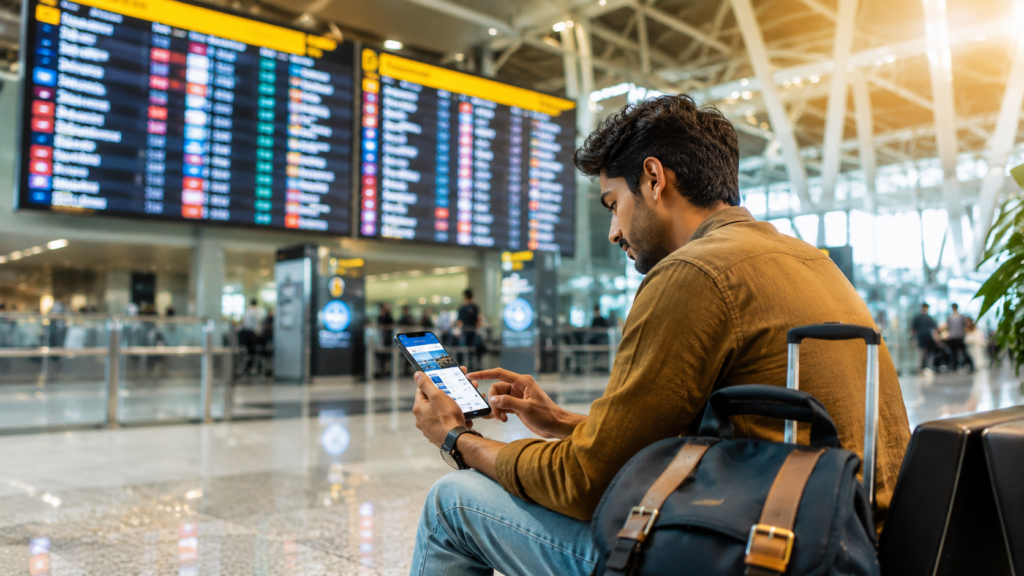
Most travelers overpay on almost every part of their trip.
Flights. Airport transfers. SIM cards. Activities. Hotels. The costs add up — not because travel is expensive, but because most people don’t know the smarter alternatives exist.
This guide changes that. These 15 tips are practical, proven, and built for real travelers who want to see the world without emptying their bank account. Apply even half of them on your next trip and the saving will surprise you.
✈️ Key Takeaways
- Use Aviasales to find flights up to 40% cheaper than booking direct
- Get an eSIM instead of roaming — saves thousands on every trip
- Pre-book airport transfers to avoid overpriced taxis on arrival
- Book activities on Klook for 20–30% off gate prices
- Travel Tuesday to Thursday for significantly cheaper flights
- Choose visa-free destinations to cut visa costs completely
Table of Contents
- Use a Flight Comparison Tool — Never Book Direct
- Travel Mid-Week for Cheaper Flights
- Book Flights 6–8 Weeks in Advance
- Choose Visa-Free Destinations
- Get an eSIM Instead of Roaming
- Pre-Book Your Airport Transfer
- Book Activities on Klook Before You Fly
- Travel in Shoulder Season
- Use One Bag — Skip Checked Luggage Fees
- Eat Local — Every Single Meal
- Use Grab Instead of Street Taxis
- Stay in Local Guesthouses
- Get a Global eSIM for Multi-Country Trips
- Share Costs with Travel Companions
- Plan Everything Before You Land
Tip 1 — Use a Flight Comparison Tool — Never Book Direct
This is the single biggest money-saving tip on this entire list. Booking flights directly through an airline’s website almost always costs more than using a comparison engine.
Aviasales searches hundreds of airlines and booking platforms simultaneously — showing you the absolute lowest available fare for any route on any date. The price difference between booking direct and using Aviasales can be significant on a single ticket — sometimes 30–40% cheaper.
How to use it correctly: enter your route, then look at the full calendar view to see which dates are cheapest. Flexibility of even 1–2 days can save you a lot.
For example — flying on a Friday might cost $220. The exact same flight on Wednesday might be $155. Aviasales shows you this instantly across all available airlines and booking platforms.
Tip 2 — Travel Mid-Week for Cheaper Flights
Tuesday, Wednesday, and Thursday are consistently the cheapest days to fly — globally. Weekends (Friday and Saturday especially) carry a price premium because that’s when most leisure travelers book.
The same route on different days of the week can vary by 20–35% in price. On a return trip that’s a significant saving from just one decision.
Mid-week travel also means less crowded airports, faster immigration queues, and better chances of getting an upgrade on partially full flights.
Tip 3 — Book Flights 6–8 Weeks in Advance
The sweet spot for cheapest flight prices is 6–8 weeks before your travel date. Earlier than that — prices are artificially high because airlines hold back inventory. Later than that — prices spike as remaining seats become scarce.
Set a price alert on Aviasales for your target route. You’ll get notified the moment the price drops to your target range — so you can book at exactly the right moment without checking manually every day.
Last-minute deals do occasionally appear but they are the exception, not the rule. Don’t gamble your travel budget on them.
Tip 4 — Choose Visa-Free Destinations
Every visa application costs money — fees, document preparation, sometimes travel agent commissions. For popular destinations, visa fees alone can be USD 50–200 per person. For a family of four, that’s USD 200–800 before you’ve even left home.
Choosing a visa-free or visa on arrival destination eliminates this cost entirely. And there are genuinely incredible places available with zero visa stress:
- 🇲🇻 Maldives — free visa on arrival, paradise beaches
- 🇳🇵 Nepal — visa free, Himalayan adventure
- 🇰🇭 Cambodia — USD 30 visa on arrival, ancient temples
- 🇱🇰 Sri Lanka — USD 20 eVisa online, beaches and history
- 🇰🇪 Kenya — visa free, world-class safari
- 🇸🇨 Seychelles — visa free, stunning island luxury
Every visa fee you don’t pay is money that goes toward your actual travel experience instead.
Tip 5 — Get an eSIM Instead of Roaming
International roaming is one of the most overpriced things in travel. You pay per megabyte, run out of data constantly, and still come home to a shocking bill.
The smart alternative is an eSIM — a digital SIM card you download to your phone before you fly. It activates automatically when you land and gives you full 4G data at local prices. No SIM card queue at the airport. No registration process. Just instant internet from the moment you land.
Airalo offers country-specific plans for Nepal, Maldives, Thailand, Malaysia, Singapore, Vietnam, Sri Lanka and more — plans start from around $4–6 for basic data. Compare that to international roaming costs and the saving is dramatic.
How to set it up in 3 steps:
- Go to Airalo and search your destination
- Choose a plan and purchase
- Install the eSIM on your phone — it activates automatically on landing
Takes 5 minutes. Saves a fortune. Absolute no-brainer for any international traveler.
Tip 6 — Pre-Book Your Airport Transfer
This is where most travelers get ripped off without realizing it.
Landing in an unfamiliar airport, tired after a long flight, most people take whatever taxi is first in line. Airport taxis in tourist destinations routinely charge 2–4x the fair rate — especially when they spot a traveler who doesn’t know local prices.
The solution: pre-book your airport transfer before you fly.
GetTransfer lets you compare prices from verified local drivers, read reviews, and lock in a fixed price before you leave home. Your driver meets you at arrivals with a name sign — no negotiation, no surprises, no getting ripped off.
For most destinations in Asia and the Middle East, a pre-booked GetTransfer costs the same or less than a metered taxi — and a fraction of what an unscrupulous airport cab charges.
Especially important for Bangkok, Kuala Lumpur, Singapore, Dubai, and Kathmandu where airport taxi scams are well documented.
Tip 7 — Book Activities on Klook Before You Fly
Buying tickets at the gate of any major attraction is almost always the most expensive option. You pay the full walk-up price, wait in long queues, and miss out on bundle deals.
Klook consistently offers 15–30% discounts on entry tickets, tours, and experiences across Asia and the Middle East. Universal Studios, Gardens by the Bay, Petronas Tower, Phuket island tours, Kathmandu day trips, Angkor Wat passes — all significantly cheaper than booking on the day.
Pre-booking on Klook also means:
- Skip-the-queue access at most attractions
- Instant confirmation on your phone
- Free cancellation on most bookings if plans change
- Bundle deals not available at the gate
For a family doing 3–4 activities, Klook savings can total USD 80–150 over the course of a single trip.
Tip 8 — Travel in Shoulder Season
Peak season means peak prices — for flights, hotels, and everything else. Shoulder season (the months just before and after peak season) gives you 80–90% of the same experience at 40–60% of the cost.
Best shoulder season windows:
- Thailand — May and September (avoid December–February and April Songkran)
- Nepal — June–August and December–February (avoid March–May and October–November trekking peak)
- Maldives — May–July (avoid December–April peak season)
- Malaysia — March–April and September–October
- Sri Lanka — April–May and September–October
Shoulder season also means fewer tourists, shorter queues, more attentive service, and a more authentic local experience. You actually enjoy popular places more when they’re not packed with peak-season crowds.
Tip 9 — Use One Bag — Skip Checked Luggage Fees
Budget airlines frequently advertise incredibly low base fares — then charge $25–50 for checked luggage per journey. On a return trip that adds $50–100 to your total cost before you’ve even sat down.
The solution: travel carry-on only. A well-packed 20-litre backpack fits 7 days worth of clothes for a warm weather destination. Pack light clothing that dries fast, wear your heaviest items on the plane, and do laundry at your accommodation.
Carry-on only also means you skip baggage claim on arrival — saving 30–45 minutes at the airport every single time. For frequent travelers, this time saving alone is worth the effort of packing light.
Tip 10 — Eat Local — Every Single Meal
Tourist restaurants near major attractions charge 3–5x what local restaurants charge for the same quality food — sometimes literally the same dish.
Walk two or three streets away from any major tourist site and you’ll find local restaurants serving authentic food at a fraction of the price.
In Thailand — pad thai at a local street stall: THB 50–80. The same dish at a tourist restaurant on Khao San Road: THB 180–250. In Malaysia — nasi lemak at a local kopitiam: MYR 5–8. Same dish at a hotel restaurant: MYR 25–35.
How to find local restaurants:
- Google Maps — filter by price level (look for ฿ or $ rated places)
- Ask your hotel or guesthouse reception — they always know the best local spots
- Follow locals at lunchtime — wherever they eat, eat there
Eating local for every meal on a 7-day trip can save USD 100–200 compared to eating exclusively at tourist spots. And the food is almost always better.
Tip 11 — Use Grab Instead of Street Taxis
In most Southeast Asian cities — Bangkok, Kuala Lumpur, Singapore, Phnom Penh, Ho Chi Minh City, Jakarta — Grab is the local equivalent of Uber. Fixed prices, no negotiation, trip tracked on your phone.
Street taxis in tourist areas frequently overcharge visitors who don’t know local prices or can’t negotiate confidently in the local language. Grab eliminates this completely — you see the price before you book and pay exactly that amount. No surprises, no arguments, no meter mysteriously running faster than usual.
Download Grab before you land. Connect a card or pay cash on arrival. It will save you money on every single journey throughout your trip.
Tip 12 — Stay in Local Guesthouses
Big hotel chains charge premium prices partly to cover their marketing budgets, loyalty program infrastructure, and brand overhead. Local guesthouses offer the same or better service — often with more character and personal attention — at 40–60% lower prices.
What to expect:
- Nepal (Kathmandu): Local guesthouses in Thamel — USD 15–30 per night, clean and comfortable
- Thailand (Bangkok): Thai guesthouses in Silom or Ari — THB 400–800 per night
- Malaysia (KL): Chinatown area guesthouses — MYR 60–120 per night
- Sri Lanka: Family guesthouses near Sigiriya or Ella — USD 20–35 including breakfast
- Cambodia: Guesthouses near Angkor Wat — USD 15–25 per night
Use Booking.com or Agoda to compare hotels and guesthouses side by side. Sort by price, check the reviews, and don’t assume a higher price means a better stay.
Tip 13 — Get a Global eSIM for Multi-Country Trips
If you’re visiting two or more countries in one trip — Nepal and Sri Lanka, Thailand and Malaysia, Kenya and Rwanda — buying a separate local SIM for each country gets expensive and complicated.
A global eSIM solves this entirely.
DrimSim works in 197 countries on a single pay-as-you-go balance. Cross a border and it switches networks automatically. One eSIM, one app, works everywhere — no swapping cards, no hunting for phone shops in unfamiliar airports.
This is the smartest solution for multi-destination travelers. Pay for exactly the data you use, in exactly the countries you visit.
Tip 14 — Share Costs with Travel Companions
Airport transfers, hotel rooms, and tour costs become dramatically cheaper per person when split between 2–4 travelers.
A private airport transfer that costs USD 40 for one person costs the same USD 40 split between four — making it USD 10 per person. Often cheaper than public transport with no effort of figuring out the bus system in a new city.
A hotel room at USD 40 per night for a single becomes USD 20 per person for two sharing. Over a week that’s USD 140 saved per person.
If you’re traveling solo, group tours through Klook let you join shared experiences with other travelers — all the benefits of a guided tour at a per-person price that’s often 40–50% cheaper than private bookings.
Tip 15 — Plan Everything Before You Land
The most expensive travel decisions are made at the airport or in an unfamiliar city when you’re tired, confused, and willing to pay anything to solve the problem quickly.
The traveler who plans in advance always spends less than the traveler who figures it out on the go. Every booking made from home is a booking made with time, research, and comparison. Every booking made at the airport is made under pressure.
Before every trip, sort these 5 things:
✅ Flights — Aviasales for cheapest fares ✅ Airport transfer — GetTransfer for fixed-price pickup ✅ eSIM — Airalo for instant data on landing ✅ Activities — Klook for discounted pre-booking ✅ Accommodation — Booking.com or Agoda for best guesthouse prices
30 minutes of planning before you fly eliminates hours of stress and significant unnecessary expense once you’re there.
How Much Can You Actually Save?
Here’s a real comparison — a 7-day Asia trip, same destination, same duration:
| Expense | Unplanned | Smart Traveler | Saving |
|---|---|---|---|
| Return flight | $280 | $190 | $90 |
| Airport transfers (both ways) | $80 | $50 | $30 |
| Mobile data | $60 (roaming) | $6 (eSIM) | $54 |
| 3 major activities | $150 | $105 (Klook) | $45 |
| Food (7 days) | $175 | $90 (local) | $85 |
| Local transport | $70 | $35 (Grab) | $35 |
| Total | $815 | $476 | $339 |
$339 saved on a single 7-day trip — nearly 42% of the total cost — just by applying these tips. Same destination. Same duration. Same quality of experience. Just smarter decisions.
FAQ
Q: What is the best way to find cheap flights for international travel? A: Use Aviasales — it compares all airlines and booking platforms simultaneously. Always search flexible dates and book 6–8 weeks in advance for the best fares.
Q: How do I avoid expensive roaming charges abroad? A: Get an eSIM before you fly. Airalo offers country-specific plans from $4–6. Downloads in minutes, activates automatically on landing.
Q: What is the cheapest time of year to travel internationally? A: Shoulder season — the months just before or after peak season for your destination. Mid-week travel also consistently produces cheaper flights than weekend departures.
Q: How do I avoid airport taxi scams? A: Pre-book your transfer before you fly with GetTransfer. Fixed price agreed in advance, verified driver, no negotiation at the airport.
Q: How do I get cheap activity tickets abroad? A: Book on Klook before departure — consistently 15–30% cheaper than gate prices, with skip-the-queue access and free cancellation on most bookings.
Q: What is the best eSIM for traveling to multiple countries? A: DrimSim works in 197 countries on a single pay-as-you-go balance — perfect for multi-destination trips. One eSIM, switches countries automatically.
Final Thoughts
Smart travel isn’t about budget accommodation and skipping experiences. It’s about eliminating the unnecessary costs that don’t add anything to your trip — overpriced airport taxis, roaming charges, full-price activity tickets, tourist restaurant markups.
Cut those out and your travel budget stretches dramatically further. You see the same places, do the same things, stay just as comfortable — but spend 30–40% less doing it.
Travel more. Spend less. See everything. 🌍
Also Read:
- Visa Free Countries for Bangladeshi Passport 2026 — Complete List
- Nepal Tourist Visa for Bangladeshi 2026 — Complete Step-by-Step Guide
- Malaysia Visa for Bangladeshi 2026 — eVisa Guide & Application Process
- Singapore Visa for Bangladeshi 2026 — Tourist Visa Complete Guide
- Best Airport Transfer in Bangkok 2026 — Cheapest & Safest Options
- GetTransfer vs KiwiTaxi vs Welcome Pickup 2026 — Which is Best?
- Best eSIM for International Travel 2026 — Top Plans Compared
- What to Do If Your Flight Is Cancelled or Delayed 2026